Last month, China’s CCTV presented a fascinating 12-part documentary series on a part of WWII not particularly well known in the West--namely, the Burma Theater. The presentation was in English, very factual and professionally done, absent of any propaganda. The program gave impartial rendering of the roles of Chiang Kai-shek, General Joe Stillwell, General Sun Liren and many others. In the second half of this series, the atrocities of the Japanese soldiers were graphically described.
Episode 6, Pincer Movement – In this episode, the Chinese troops from India entered Burma and mounted a large scale offensive and scored a major victory. They over ran Japanese division command headquarters, and the Japanese incurred heavy casualties, more than twice as many as the Chinese side. This is unprecedented up to now. Chinese success can be attributed to better trained and better equipped soldiers. Just as critical was American air support. American planes provide air cover, detailed maps of the terrain via recon flights and timely drops of arms and supplies.
Episode 7, Victory at Myitkyina – While the battle in episode 6 was going on, General Stillwell conceived of a brilliant surprise attack to capture a strategic airfield at Myitkyina. The capture of the airfield would enable the Allies to fly in troops to the front line of battle. The surprise attack was successful but unfortunately the commanding General Frank Merrill (of the famed Merrill Marauders) made a terrible decision not to press on and take the town while the Allies had overwhelming numerical advantage and thus allowed the Japanese to send in reinforcements. It then took the Chinese troops another two months at great cost in casualty to finally capture the town of Myitkyina. This victory at Myitkyina marked the beginning of the end of the Japanese in Burma.
Episode 8, Stalemate at Nujiang River – While previous two episodes described the successes of forces under Stillwell’s command, this episode talked about the stalemate in southwestern Yunnan where the Japanese forces held on to the west bank while the Chinese were in the east bank. This stalemate lasted for two years. During this time, the Japanese troops committed all forms of atrocities against the local people in their territory. Besides usual gang rape of women, random killing and bayoneting, a particularly gruesome practice was described. The soldiers would bend a tall bamboo sapling and tied the entrails from the rectum of the victim and then watched in great entertainment when the bamboo snapped back and dangled the victim by the stretched out intestines. These activities were a deliberate attempt to dehumanize the Japanese soldiers so that they could become unfeeling fighting machine. Each soldier were given two coupons per week that entitled them to the services of comfort woman. The comfort women, mostly from the local villages, did not even have time to eat but must eat while servicing their clients. After the Americans re-equipped the Chinese, FDR began to push for offensive against the Japanese across the river. CKS reluctantly agreed but by then, in April of 1944, the rainy season was upon them.
Episode 9, Battle of Gaoligong Shan – Commander of the Yunnan based Chinese troops was General Wei Lihuang. He devised a pincer surprise attack on the Japanese via a small mountainous road, not used in generations. Alas his plans fell into Japanese hands and they were dug in and prepared. A bitter hard fought battle ensued. The difference that turned the tide was the minority people of those mountains. They willingly fought alongside, provided food and supplies and as porters for the supplies. The Japanese had no local support and were cut off. Afterwards, the Chinese found plenty of evidence that the Japanese resorted to eating human flesh, smoked, boiled and dried. They even found evidence of Japanese soldiers trapped in pillboxes having to eat the flesh of their fallen comrades.
Episode 10, Battle of Songshan – Having encountered heavy resistance in Gaoligong, General Wei and his staff changed their plans and moved their troops southward to attack Songshan, the highest point that looks down the Yunnan Burma Road. Again their intelligence proved faulty and the Chinese encountered heavy resistance from far more troops than anticipated. It took three months of hard fighting and a casualty of 7000 to finally secure the top of Songshan and about 1000 Japanese dead.
Episode 11, Capture of Tengchong – Capture of Tengchong was crucial to the allied plans to re-open the Burma Road and join forces with the Chinese troops from India. The capture did not come easy. The walls of Tengchong could not be breeched by regular gun fire. It took American bomber planes many runs to create openings for the Chinese soldiers. The wall was built during the Ming dynasty made from volcanic rocks.
Episode 12, Battle of Longling – Concurrent with the battles of Songshan and Tengchong, another part of the Expeditionary Forces were dispatched to capture Longling. Longling sat at the junction of the Yunnan Burma Road and the road to India and its capture would mean the reopening of the lifeline to China. The battle took 4 months and three major offensives before the Japanese troops were pounded into submission and totally annihilated. The victory was complete when the forces then moved south to Burma and joined the Chinese forces from India. January 1945 marked the end of Japan’s influence in Southeast Asia. The Chinese sent forces into Burma in 1942 and again in 1945 at great cost suffering casualty of nearly 100,000. They could not have won without the air cover provided by the American Air Force and the heavy artillery supplied by the Americans.
It was one of the highlights of US-China bilateral colloboration in WWII.
Wednesday, September 1, 2010


Monday, August 30, 2010
Don't Miss this Documentary on WWII History, Part 1
This month, China’s CCTV presented a fascinating 12-part documentary series on a part of WWII not particularly well known in the West--namely, the Burma Theater. The presentation was in English, very factual and professionally done, absent of any propaganda. The program gave impartial rendering of the roles of Chiang Kai-shek, General Joe Stillwell, General Sun Liren and many others. The one nation that did not come out very well was UK. They were portrayed as arrogant, treacherous and had no stomach for battle.
Episode 1, Arduous expedition – By 1941, the Burma Road was the only lifeline to the outside world remaining for China. CKS recognized the strategic importance and sent an expeditionary troops of 100,000 to fight alongside the British. Undermanned and underequipped, the troops fought the Japanese to a standstill for 12 days at Toungoo until the Brits unilaterally withdrew, thus exposing the flanks to the Japanese and leaving the Chinese surrounded and cut-off. The Chinese under the command of Dai Anlan managed an orderly withdraw with a casualty of under 2000 compared to 5000 of the Japanese. The Japanese occupied an empty town and the Japanese general ordered the burial of all the Chinese dead with honors for their bravery.
Episode 2, Rescuing the Brits – The Brits plus the Chinese soldiers had the Japanese outnumbered, but the Brits ran until they were trapped by a pincer movement and it remained for the Chinese to come to their rescue again. About 800 of Sun Liren’s crack troops rescued the 7000 British troops, dying because of lack of drinking water. For this act of bravery, General Sun was awarded the medal of the highest honor by the British government. The actual general in command was Liu Fangwu who was to go unrecognized until much later when Margaret Thatcher visited the U.S. and personally thanked him. Despite this rescue, The Brits still had their own agenda which was not to defend Burma. They withdrew towards India without telling the Chinese and blew the Mandalay Bridge behind them and thus cut off the Chinese retreat back to China. The Chinese was to pay dearly when the Japanese used stealth to go behind the Chinese and cut off their retreat to China.
Episode 3, Ordeal on Savage Mountain – While the Brits withdrew to India, CKS did not want the Chinese to follow suit for fear of losing the command to the Brits. Du Yuming obeyed and order his command to retreat northward across primordial forest called Savage Mountain (野人山) where most his troops were decimated by disease and starvation. A fallen soldier was nearly instantly turned into skeletons by leeches, ants and others that crawl in the jungles. The 200th Division commanded by Dai fought rear guard action and were the last to leave. Dai was wounded and died and his body was carried all the way back to China by his followers. Sun Liren did not heed Du’s orders, reasoning the primordial forest was deadly to his troops. Instead his troops marched southward, caught the Japanese by surprise and broke through and then headed westward into India. The Brit commanding general ordered Sun’s troops to stand down and disarm at the border. Sun threaten to fight into India. Just in time, the general of the Brit troops rescued in Burma rushed to see the commanding general to tell him that his British troops were no match for Sun’s and it was no way to pay back for the heroic rescue. Of the 100,000 Chinese troops sent into Burma, only about 30,000 survived.
Episode 4, Recuperating in India – Sun’s 38th Division virtually intact became the core fighting force resting in Ramgarh. The remnants of 22nd Division that straggled out of Savage Mountain joined. General Stillwell finally had an opportunity to build a fighting force directly under his command and he equipped and trained the two divisions with the best weaponry possible. Sun also asked CKS to send him new recruits to fill the ranks of his army and CKS responded by sending patriotic students as recruits. The British was responsible for provisioning the troops. For the first time, the Chinese soldiers had two sets of boots, two underwear, two pairs of thick socks and two pairs of thin socks, etc. Sun with the help of American trainers taught his troops not only how to fight, but how to swim with pack, to climb mountain and walk in jungles. He was getting the two divisions ready to engage the Japanese with trained and toughened soldiers better equipped to fight than the Japanese. The American objective in Burma was to tied down the Japanese troops, the Chinese to keep the lifeline open while the Brits had interest in Burma only to the extent it would keep the Japanese from invading India.
Episode 5, Counter attack begins – Finally the counter attack by the Chinese troops from India to northern Burma began in this episode. The Chinese soldiers were entirely different from those that fought earlier when they along with the Brits were defeated by the Japanese and had to retreat to India. These were physically fit, well trained and well equipped. This was the beginning of the turning of the tide. They were to face the crack Japanese troops that fought in Shanghai, participated in the Nanking massacre and occupied Singapore despite greatly outnumbered by the British troops stationed there, troops that had no stomach for fighting. At the Cairo Conference CKS thought he got Churchill's agreement to commit the British troops to the joint counter attack. Few days later, Churchill reneged and decided not to join in the battle.
Episode 1, Arduous expedition – By 1941, the Burma Road was the only lifeline to the outside world remaining for China. CKS recognized the strategic importance and sent an expeditionary troops of 100,000 to fight alongside the British. Undermanned and underequipped, the troops fought the Japanese to a standstill for 12 days at Toungoo until the Brits unilaterally withdrew, thus exposing the flanks to the Japanese and leaving the Chinese surrounded and cut-off. The Chinese under the command of Dai Anlan managed an orderly withdraw with a casualty of under 2000 compared to 5000 of the Japanese. The Japanese occupied an empty town and the Japanese general ordered the burial of all the Chinese dead with honors for their bravery.
Episode 2, Rescuing the Brits – The Brits plus the Chinese soldiers had the Japanese outnumbered, but the Brits ran until they were trapped by a pincer movement and it remained for the Chinese to come to their rescue again. About 800 of Sun Liren’s crack troops rescued the 7000 British troops, dying because of lack of drinking water. For this act of bravery, General Sun was awarded the medal of the highest honor by the British government. The actual general in command was Liu Fangwu who was to go unrecognized until much later when Margaret Thatcher visited the U.S. and personally thanked him. Despite this rescue, The Brits still had their own agenda which was not to defend Burma. They withdrew towards India without telling the Chinese and blew the Mandalay Bridge behind them and thus cut off the Chinese retreat back to China. The Chinese was to pay dearly when the Japanese used stealth to go behind the Chinese and cut off their retreat to China.
Episode 3, Ordeal on Savage Mountain – While the Brits withdrew to India, CKS did not want the Chinese to follow suit for fear of losing the command to the Brits. Du Yuming obeyed and order his command to retreat northward across primordial forest called Savage Mountain (野人山) where most his troops were decimated by disease and starvation. A fallen soldier was nearly instantly turned into skeletons by leeches, ants and others that crawl in the jungles. The 200th Division commanded by Dai fought rear guard action and were the last to leave. Dai was wounded and died and his body was carried all the way back to China by his followers. Sun Liren did not heed Du’s orders, reasoning the primordial forest was deadly to his troops. Instead his troops marched southward, caught the Japanese by surprise and broke through and then headed westward into India. The Brit commanding general ordered Sun’s troops to stand down and disarm at the border. Sun threaten to fight into India. Just in time, the general of the Brit troops rescued in Burma rushed to see the commanding general to tell him that his British troops were no match for Sun’s and it was no way to pay back for the heroic rescue. Of the 100,000 Chinese troops sent into Burma, only about 30,000 survived.
Episode 4, Recuperating in India – Sun’s 38th Division virtually intact became the core fighting force resting in Ramgarh. The remnants of 22nd Division that straggled out of Savage Mountain joined. General Stillwell finally had an opportunity to build a fighting force directly under his command and he equipped and trained the two divisions with the best weaponry possible. Sun also asked CKS to send him new recruits to fill the ranks of his army and CKS responded by sending patriotic students as recruits. The British was responsible for provisioning the troops. For the first time, the Chinese soldiers had two sets of boots, two underwear, two pairs of thick socks and two pairs of thin socks, etc. Sun with the help of American trainers taught his troops not only how to fight, but how to swim with pack, to climb mountain and walk in jungles. He was getting the two divisions ready to engage the Japanese with trained and toughened soldiers better equipped to fight than the Japanese. The American objective in Burma was to tied down the Japanese troops, the Chinese to keep the lifeline open while the Brits had interest in Burma only to the extent it would keep the Japanese from invading India.
Episode 5, Counter attack begins – Finally the counter attack by the Chinese troops from India to northern Burma began in this episode. The Chinese soldiers were entirely different from those that fought earlier when they along with the Brits were defeated by the Japanese and had to retreat to India. These were physically fit, well trained and well equipped. This was the beginning of the turning of the tide. They were to face the crack Japanese troops that fought in Shanghai, participated in the Nanking massacre and occupied Singapore despite greatly outnumbered by the British troops stationed there, troops that had no stomach for fighting. At the Cairo Conference CKS thought he got Churchill's agreement to commit the British troops to the joint counter attack. Few days later, Churchill reneged and decided not to join in the battle.
Saturday, July 31, 2010
Bill Richardson Makes Important Decision
Governor of state of New Mexico is deliberating on whether to posthumously pardon Billy the Kid, some 130 years after he was gunned down as an outlaw.
One would have to admire Governor Bill Richardson for his willingness to tackle such a weighty issue and one would likely jump to the conclusion that unlike its neighbors, all must be well in New Mexico.
Unlike Arizona, New Mexico must not have any conflict over illegal immigrants.
Unlike Nevada, Richardson’s state must be enjoying robust employment.
Unlike California, he must not have to wrestle with budget deficits.
And for sure unlike the rest of the country, New Mexico’s school system must be doing just fine and leaving no child behind.
Hard to know how the people of New Mexico feel about their governor, but surely William Bonney is rolling over in his grave in gratitude.
One would have to admire Governor Bill Richardson for his willingness to tackle such a weighty issue and one would likely jump to the conclusion that unlike its neighbors, all must be well in New Mexico.
Unlike Arizona, New Mexico must not have any conflict over illegal immigrants.
Unlike Nevada, Richardson’s state must be enjoying robust employment.
Unlike California, he must not have to wrestle with budget deficits.
And for sure unlike the rest of the country, New Mexico’s school system must be doing just fine and leaving no child behind.
Hard to know how the people of New Mexico feel about their governor, but surely William Bonney is rolling over in his grave in gratitude.
Sunday, July 11, 2010
Borobudur near Yogyakarta, Indonesia
Four days in Yogyakarta (Yogya for short and first y is pronounced as a j) were enough to form some impressions about Indonesia. The roads we traveled on were by and large in good shape though some in the countryside can be quite narrow and for this reason favored smaller, narrower foot print cars. Especially in the city, the streets swarmed with motorbikes. I guessed that for every car, there might be 10 mopeds and the like but our guide thought the ratio was closer to 25 to 1. Most of the scooters and mopeds looked less than 3 years old, perhaps an indicator of the recent improvements in the Indonesian economy. Most people, particularly in the city, wore helmets when they rode or drove the motor bikes. Ironically, young children rode sandwiched between their parents and usually were without helmets. 
Despite varying degrees of aggressiveness among the drivers, the traffic was fairly orderly. We did not witness any road rage or arguments and did not see any traffic collisions. In general the people were friendly to each other and to foreign visitors. I believe the gentleness of Javanese culture fosters harmony among the people far more successfully than say the Chinese culture has.
It’s no surprise that Indonesia, being a nation of archipelagoes, has many ethnic people and many local languages. Bahasa is the national language that was created in the 1930’s by revolutionaries as part of the attempt to unify the chain of islands that was to become the nation of Indonesia. The language apparently borrowed a lot from the Dutch and looked easy to learn. Some words were naturally intuitive such as gratis, polisi (police), taksi (taxi), apotek (pharmacy). Other words, we saw so often that we can figured out what they meant, for example, masuk (enter) and keluar (exit), nasi goreng for fried rice and mie goreng for chow mein.
Day 1
We left Singapore in the midst of a huge tropical storm. The Air Asia flight was only a few minutes late. Yogyakarta airport did not have gates that connect directly to the terminal but we alit on the tarmac and walked into a small entry to go through immigration. Buying the visa on arrival was actually a shorter line than the line for foreigners carrying passports with visas already in them. On the spot tourist visa at $25 per person was also cheaper than getting it ahead of time in America. Mr. Herry, our guide, was late getting to the airport so that a momentary panic was creeping in when he showed up. I had just gotten a new HTC Droid phone and did not really know how to use it yet and was trying to call Mr. Herry when he appeared.
 Prambanan temple complex was located near the airport, both east of Yogya. The temple complex was restored from rubble of gray volcanic rocks that we were to see a lot of during this visit. Volcanic rocks being the most available were used to erect temples, unfortunately without any binders. The tongue and groove method of constructions proved unable to resist the shaking from the movement of the faults over the centuries. While the volcanoes provided the building material, the earthquakes destroyed the man-made structures leaving piles of rocks for puzzle loving archeologists to solve.
From Prambanan, we headed west into the city of Yogyakarta to the Phoenix Hotel. Phoenix was located near the center of town but not in a very interesting neighborhood. The hotel itself was interesting from an architecture point of view, converted from a previous British estate.
Day 2
We got up at 3:30 AM in order to be picked up at 4 to see the sunrise at Borobudur. The sunrise tour was available exclusively through the Manohara Resort Hotel situated next to the site. The tour included a give-away flashlight for each person and tea or coffee with pastries afterwards. We could have selected a tour that included staying at the Manohara and sleep an hour longer. The other advantage was that the temple was just a short walk away and hotel guests could then go to the Borobudur at any time at no extra admission charge. For anyone thinking of seeing only Borobudur and not stay in the area for more than 2 nights, Manohara would have been an appealing option.
 We were not rewarded with a spectacular sunrise as we took the dawn trek up the terraced temple site but we did enjoy the serenity of the morning calm undisturbed by any throng of noisy tourists—which we were to meet on our way down. From the top of Borobudur, we watched the post-dawn fog rolled into the valley providing a veil over the hillside and the light from the sun behind the clouds gradually giving definition to sculptures of sitting Buddha in various poses of meditation.
  On our descent, we made partial circles of each terrace to enjoy the artistry of sculptured stone panels. On the very bottom terrace, Mr. Herry told us to go clockwise from the east gate to see the beginning-to-end portrayal of Ramayana, the classic Hindu epic of good vs. evil, abduction and rescue, heroic battles and heart breaking suspicion of marital infidelity.
In line with the Borobudur were two other small Buddhist temples that we stopped briefly to see. Be they Hindu or Buddhist, the temples were uniformly gray due to the use of volcanic rocks. The differences in style were subtle and the casual tourist would be tempted to dismiss them in the mold of “seen one, seen them all.”
From Borobudur we drove back to Yogya and headed for the Sultan’s Palace and then the Water Palace where once the Sultan and his many wives cavorted. The Sultan’s palace was in part a museum and in part the living quarters of the current and 10th Sultan and his family (off limits to visitors). We were told that the Sultan’s father (the 9th) joined the struggle for independence from the Dutch early on and at one time served as the vice president of Indonesia when Suharto reigned as president for life. The tenth is the current governor of the province that has Yogya as the capital.
Our guide also took us to a batik making factory and show room and then to a silver shop called Ansor in the southern part of the city. Both were located in upscale neighborhoods.
We got back to our hotel shortly after noon but it already seemed like a long day for us. We walked to a nearby Chinese restaurant for a late lunch. We ordered mie gorang (chow mein) along with chicken with vegetable and pork with pickled vegetables. We must have been hungry and felt that we didn’t have enough to eat and supplemented with an order of nasi gorang (fried rice). Food was inexpensive in Indonesia while beer was comparatively more pricey though still cheap compared to US prices. For dinner last night and lunch today, we ate for less than the equivalent of ten dollars but a large bottle of beer cost about $3.
We were supposed to see a performance of the Ramayana ballet tonight. We ended up in traffic gridlock and Herry saw that we were not going to make it on time. He quickly cleared with his boss and changed our attendance to the following night. Even then turning around and getting out of the traffic was a challenge. The driver of the car obstructed by our driver’s attempt to make a U turn on a narrow two-lane road quickly got out of his car to halt traffic so that our driver could complete the maneuver smoothly. Nobody honked but waited patiently. We found out later that there was a chemical fire near the theatre that had caused the traffic congestion.
Day 3
We didn’t have to leave quite so early but it was still a 7:30 AM departure. We were heading for Dieng Plateau, about 3.5 hours away. Along the way, we came to a farmer’s market on a small village half way up the mountain. At the lookout point, our next stop, someone spoke to May first in English to find out if she spoke Chinese and then broke into Mandarin. They are overseas Chinese apparently many generations in Indonesia but still they felt so proud of China’s achievement and talked wistfully of visiting China someday.
The ostensible object of our tour today was the oldest known Hindu temple complex dating back to 5th century AD and only restored in 2008. This temple complex was on a much lesser scale than Prambanan and couldn’t justify a trip on its own merit. On the plateau we then came to scalding hot springs and Lake Warna, known for multi-colored water in a scenic setting. On the way home, we stopped at a roadside restaurant known for their satay for a real cheap meal. By chance a parade celebrating a mass circumcision of boys coming of age (10) and their families riding in horse carts came by. The designated boys dressed in white were being honored and unaware that they were about to encounter the first traumatic experience of their young lives.
Tonight we attended the Ramayana ballet that we missed the previous night. It was lightly attended, consisting of one Japanese tour group and one European tour group along with a handful of others, altogether may be 40 in the audience. It was colorfully costumed and appeared to be well done. We were given an English description of the story so that it was easy to follow along. The actors/dancers were good at catching arrows shot at them across the stage, that and one of the actors rolling on a trough of fire added color to the performance.
Day 4
This was another early morning departure at 7 AM. About an hour later, we were at the slopes of the Merapi volcano, youngest of 11 active ones on Java at about 150 million years old. Herry showed us the bunker where two foreign journalists were baked to death during the eruption of 2004, when the lava flow went right over the bunker. After some roadside photo stops, we went into Solo, also known as Surakarta (pop. 900,000), a much newer and more modern city than Yogya (pop. 600,000). Our first stop was to see the Sultan’s Palace, where the ninth, 58, still lived there with his second wife and kids. His first wife was a daughter of Sukarno. Not being an early supporter of independence, he did not become governor of his province.
The palace was nicely kept up since the Sultan still lived inside with his immediate family. As our guide explained, the sultan still ruled inside the palace grounds. The visitor can take photos on the grounds and inside the first reception hall but not inside the next room, which doubled as former throng room and a museum of the sultan’s memorabilia. There were some priceless jewelry and other objects of art, but it was poorly displayed in dim lighting that greatly detracted from the appeal.
After the palace tour, we went to a nearby Chinese restaurant for lunch. The owner came to speak Chinese with us. One of his sons was cutting swatches from rolls of material. The material is for an apparel factory that he also runs, he explained.
We had fried whole fish, sautee’d soft shell crab, spinach and chow mein, plus beer and tea for under $14 but nearly took all the Rupiahs in my wallet. The ATMs in Indonesia worked very nicely. Usually the maximum amount one can withdraw at one time was one million Rupiahs. I was to feel like a millionaire about three times while in Yogya.
After lunch, we went to see the antique market, said to be the largest in Java. The shop owners did not seemed to be doing much business and made only half hearted attempts to entice us into their stores. We probably look too much like tourists and not like serious buyers.
Nearby was the so called Solo’s Chinatown. It consisted of one large complex that looked like any farmers’ market selling fresh produce, fruits, meats, herbs, and other sundries. Across the way, sandwiched between two larger buildings was a Chinese temple. The temple was undergoing renovation, especially being painted. The smell of paint persuaded us not to tarry.
Day 5
We got up early in the morning again to catch a 7 AM AirAsia flight back to Singapore. One thing our guide forgot to tell us was airport departure tax, which was 100,000 Rupiahs per person. I thought I had carefully and cleverly spent every one of my Rupiahs the night before only to having to make a last minute change of my Singapore dollars to pay for the departure tax.
Reflections:
Judging from a scarcity of bicycles on the road (but numerous new scooters and mopeds) and relatively few beggars on the streets, I have the impression that Indonesia’s current government is working effectively and the country is on a trajectory of economic growth. However, we did not see modern high rises. Pedicabs out-numbered taxis and most restaurants were not air conditioned. Therefore Indonesia does not appear to be on the verge of an economic boom like that of China.
Historically, Java had its share of powerful kingdoms but apparently never one strong enough to take control of the entire island and perpetuate a culture and language that would endure. Consequently, the people of Java do not enjoy an institutional memory of the glory days of old. Borobudur, Prambanan and other edifices are man-made wonders without the benefit of human records and thus remain enigmas for generations to ponder.
Getting there: AirAsia offers non-stop flights between Singapore and Yogyakarta. Other airlines connect via Jarkarta and turn the 2 hour flight into a much longer proposition. Everything with this no-frills airline is a la carte. You can prepay your meal and be the first ones to eat and you are charged for checked baggage depending on the weight (free for one carry-on plus one personal handbag). By booking well in advance, I got two round trip tickets for around US$350, meals included.

Despite varying degrees of aggressiveness among the drivers, the traffic was fairly orderly. We did not witness any road rage or arguments and did not see any traffic collisions. In general the people were friendly to each other and to foreign visitors. I believe the gentleness of Javanese culture fosters harmony among the people far more successfully than say the Chinese culture has.
It’s no surprise that Indonesia, being a nation of archipelagoes, has many ethnic people and many local languages. Bahasa is the national language that was created in the 1930’s by revolutionaries as part of the attempt to unify the chain of islands that was to become the nation of Indonesia. The language apparently borrowed a lot from the Dutch and looked easy to learn. Some words were naturally intuitive such as gratis, polisi (police), taksi (taxi), apotek (pharmacy). Other words, we saw so often that we can figured out what they meant, for example, masuk (enter) and keluar (exit), nasi goreng for fried rice and mie goreng for chow mein.
Day 1
We left Singapore in the midst of a huge tropical storm. The Air Asia flight was only a few minutes late. Yogyakarta airport did not have gates that connect directly to the terminal but we alit on the tarmac and walked into a small entry to go through immigration. Buying the visa on arrival was actually a shorter line than the line for foreigners carrying passports with visas already in them. On the spot tourist visa at $25 per person was also cheaper than getting it ahead of time in America. Mr. Herry, our guide, was late getting to the airport so that a momentary panic was creeping in when he showed up. I had just gotten a new HTC Droid phone and did not really know how to use it yet and was trying to call Mr. Herry when he appeared.
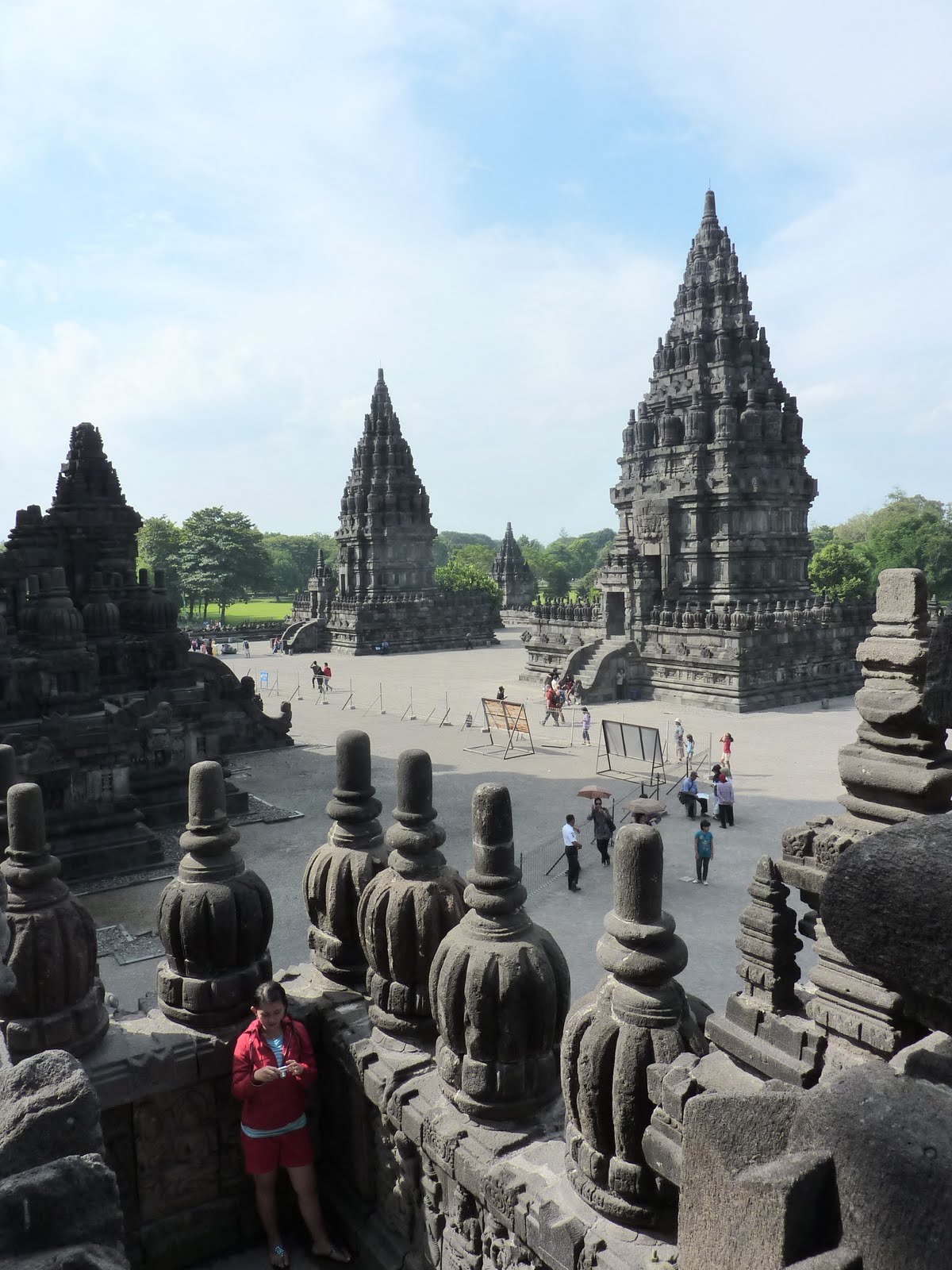 Prambanan temple complex was located near the airport, both east of Yogya. The temple complex was restored from rubble of gray volcanic rocks that we were to see a lot of during this visit. Volcanic rocks being the most available were used to erect temples, unfortunately without any binders. The tongue and groove method of constructions proved unable to resist the shaking from the movement of the faults over the centuries. While the volcanoes provided the building material, the earthquakes destroyed the man-made structures leaving piles of rocks for puzzle loving archeologists to solve.
From Prambanan, we headed west into the city of Yogyakarta to the Phoenix Hotel. Phoenix was located near the center of town but not in a very interesting neighborhood. The hotel itself was interesting from an architecture point of view, converted from a previous British estate.
Day 2
We got up at 3:30 AM in order to be picked up at 4 to see the sunrise at Borobudur. The sunrise tour was available exclusively through the Manohara Resort Hotel situated next to the site. The tour included a give-away flashlight for each person and tea or coffee with pastries afterwards.
 We could have selected a tour that included staying at the Manohara and sleep an hour longer. The other advantage was that the temple was just a short walk away and hotel guests could then go to the Borobudur at any time at no extra admission charge. For anyone thinking of seeing only Borobudur and not stay in the area for more than 2 nights, Manohara would have been an appealing option.
 We were not rewarded with a spectacular sunrise as we took the dawn trek up the terraced temple site but we did enjoy the serenity of the morning calm undisturbed by any throng of noisy tourists—which we were to meet on our way down. From the top of Borobudur, we watched the post-dawn fog rolled into the valley providing a veil over the hillside and the light from the sun behind the clouds gradually giving definition to sculptures of sitting Buddha in various poses of meditation.
  On our descent, we made partial circles of each terrace to enjoy the artistry of sculptured stone panels. On the very bottom terrace, Mr. Herry told us to go clockwise from the east gate to see the beginning-to-end portrayal of Ramayana, the classic Hindu epic of good vs. evil, abduction and rescue, heroic battles and heart breaking suspicion of marital infidelity.
 In line with the Borobudur were two other small Buddhist temples that we stopped briefly to see. Be they Hindu or Buddhist, the temples were uniformly gray due to the use of volcanic rocks. The differences in style were subtle and the casual tourist would be tempted to dismiss them in the mold of “seen one, seen them all.”
From Borobudur we drove back to Yogya and headed for the Sultan’s Palace and then the Water Palace where once the Sultan and his many wives cavorted. The Sultan’s palace was in part a museum and in part the living quarters of the current and 10th Sultan and his family (off limits to visitors). We were told that the Sultan’s father (the 9th) joined the struggle for independence from the Dutch early on and at one time served as the vice president of Indonesia when Suharto reigned as president for life. The tenth is the current governor of the province that has Yogya as the capital.

Our guide also took us to a batik making factory and show room and then to a silver shop called Ansor in the southern part of the city. Both were located in upscale neighborhoods.
We got back to our hotel shortly after noon but it already seemed like a long day for us. We walked to a nearby Chinese restaurant for a late lunch. We ordered mie gorang (chow mein) along with chicken with vegetable and pork with pickled vegetables. We must have been hungry and felt that we didn’t have enough to eat and supplemented with an order of nasi gorang (fried rice).
 Food was inexpensive in Indonesia while beer was comparatively more pricey though still cheap compared to US prices. For dinner last night and lunch today, we ate for less than the equivalent of ten dollars but a large bottle of beer cost about $3.
We were supposed to see a performance of the Ramayana ballet tonight. We ended up in traffic gridlock and Herry saw that we were not going to make it on time. He quickly cleared with his boss and changed our attendance to the following night. Even then turning around and getting out of the traffic was a challenge. The driver of the car obstructed by our driver’s attempt to make a U turn on a narrow two-lane road quickly got out of his car to halt traffic so that our driver could complete the maneuver smoothly. Nobody honked but waited patiently. We found out later that there was a chemical fire near the theatre that had caused the traffic congestion.
Day 3
We didn’t have to leave quite so early but it was still a 7:30 AM departure. We were heading for Dieng Plateau, about 3.5 hours away. Along the way, we came to a farmer’s market on a small village half way up the mountain. At the lookout point, our next stop, someone spoke to May first in English to find out if she spoke Chinese and then broke into Mandarin. They are overseas Chinese apparently many generations in Indonesia but still they felt so proud of China’s achievement and talked wistfully of visiting China someday.
The ostensible object of our tour today was the oldest known Hindu temple complex dating back to 5th century AD and only restored in 2008. This temple complex was on a much lesser scale than Prambanan and couldn’t justify a trip on its own merit. On the plateau we then came to scalding hot springs and Lake Warna, known for multi-colored water in a scenic setting. On the way home, we stopped at a roadside restaurant known for their satay for a real cheap meal. By chance a parade celebrating a mass circumcision of boys coming of age (10) and their families riding in horse carts came by.
 The designated boys dressed in white were being honored and unaware that they were about to encounter the first traumatic experience of their young lives.
Tonight we attended the Ramayana ballet that we missed the previous night. It was lightly attended, consisting of one Japanese tour group and one European tour group along with a handful of others, altogether may be 40 in the audience. It was colorfully costumed and appeared to be well done. We were given an English description of the story so that it was easy to follow along. The actors/dancers were good at catching arrows shot at them across the stage, that and one of the actors rolling on a trough of fire added color to the performance.
Day 4
This was another early morning departure at 7 AM. About an hour later, we were at the slopes of the Merapi volcano, youngest of 11 active ones on Java at about 150 million years old. Herry showed us the bunker where two foreign journalists were baked to death during the eruption of 2004, when the lava flow went right over the bunker.
 After some roadside photo stops, we went into Solo, also known as Surakarta (pop. 900,000), a much newer and more modern city than Yogya (pop. 600,000). Our first stop was to see the Sultan’s Palace, where the ninth, 58, still lived there with his second wife and kids. His first wife was a daughter of Sukarno. Not being an early supporter of independence, he did not become governor of his province.
The palace was nicely kept up since the Sultan still lived inside with his immediate family. As our guide explained, the sultan still ruled inside the palace grounds. The visitor can take photos on the grounds and inside the first reception hall but not inside the next room, which doubled as former throng room and a museum of the sultan’s memorabilia. There were some priceless jewelry and other objects of art, but it was poorly displayed in dim lighting that greatly detracted from the appeal.
After the palace tour, we went to a nearby Chinese restaurant for lunch. The owner came to speak Chinese with us. One of his sons was cutting swatches from rolls of material. The material is for an apparel factory that he also runs, he explained.
We had fried whole fish, sautee’d soft shell crab, spinach and chow mein, plus beer and tea for under $14 but nearly took all the Rupiahs in my wallet. The ATMs in Indonesia worked very nicely. Usually the maximum amount one can withdraw at one time was one million Rupiahs. I was to feel like a millionaire about three times while in Yogya.
After lunch, we went to see the antique market, said to be the largest in Java. The shop owners did not seemed to be doing much business and made only half hearted attempts to entice us into their stores. We probably look too much like tourists and not like serious buyers.
Nearby was the so called Solo’s Chinatown. It consisted of one large complex that looked like any farmers’ market selling fresh produce, fruits, meats, herbs, and other sundries. Across the way, sandwiched between two larger buildings was a Chinese temple. The temple was undergoing renovation, especially being painted. The smell of paint persuaded us not to tarry.
Day 5
We got up early in the morning again to catch a 7 AM AirAsia flight back to Singapore. One thing our guide forgot to tell us was airport departure tax, which was 100,000 Rupiahs per person. I thought I had carefully and cleverly spent every one of my Rupiahs the night before only to having to make a last minute change of my Singapore dollars to pay for the departure tax.
Reflections:
Judging from a scarcity of bicycles on the road (but numerous new scooters and mopeds) and relatively few beggars on the streets, I have the impression that Indonesia’s current government is working effectively and the country is on a trajectory of economic growth. However, we did not see modern high rises. Pedicabs out-numbered taxis and most restaurants were not air conditioned. Therefore Indonesia does not appear to be on the verge of an economic boom like that of China.
Historically, Java had its share of powerful kingdoms but apparently never one strong enough to take control of the entire island and perpetuate a culture and language that would endure. Consequently, the people of Java do not enjoy an institutional memory of the glory days of old. Borobudur, Prambanan and other edifices are man-made wonders without the benefit of human records and thus remain enigmas for generations to ponder.
Getting there: AirAsia offers non-stop flights between Singapore and Yogyakarta. Other airlines connect via Jarkarta and turn the 2 hour flight into a much longer proposition. Everything with this no-frills airline is a la carte. You can prepay your meal and be the first ones to eat and you are charged for checked baggage depending on the weight (free for one carry-on plus one personal handbag). By booking well in advance, I got two round trip tickets for around US$350, meals included.
Friday, June 11, 2010
In Taiwan's Corruption Trial of the Ages, Money Talks
Taiwan's high court has ruled on former President Chen Shui-bian's conviction for money laundering, corruption, falsifying documents and accepting bribes. The high court's ruling did not overturn Chen's conviction from a lower court but lessened the penalty of his crimes. The most obvious was to reduce his life imprisonment to 20years in jail. Instead of being deprived of his citizen's rights for life, it is now only ten years.
There were no explanation given for the reduction of penalty which left open the speculation that perhaps Taiwan's judiciary is still hoping to recover the rest of the funds Chen and his family had illicitly absconded and put in overseas accounts.
Chen's family has been remitting funds from various overseas accounts in drips and drabs back to Taiwan apparently as part of the negotiating strategy with Taiwan's judiciary.
The strategy seems to be working. Chen said in court that he can guarantee the return of the remaining 570 million NT dollars held overseas within one week of his release on bail. Nothing subtle about Chen. To him, money has always talked louder than rule of law.
In the court room, Chen's supporters went through the motion of protesting loudly because Chen did not get exoneration but a mere term reduction, albeit with big smiles on their faces.
In Taiwan's peculiar brand of democracy, who knows how many more remittances it will take for Chen to become a free man? He apparently has two more layers of the courts where he can take his plea and by judiciously parcelling out the return of his ill gotten gains, he just might be able to buy his way out of jail.
I am hardly the only person to point out the inconsistency of the latest ruling. See for instance a translation of an editorial of one of Taiwan's major newspaper.
There were no explanation given for the reduction of penalty which left open the speculation that perhaps Taiwan's judiciary is still hoping to recover the rest of the funds Chen and his family had illicitly absconded and put in overseas accounts.
Chen's family has been remitting funds from various overseas accounts in drips and drabs back to Taiwan apparently as part of the negotiating strategy with Taiwan's judiciary.
The strategy seems to be working. Chen said in court that he can guarantee the return of the remaining 570 million NT dollars held overseas within one week of his release on bail. Nothing subtle about Chen. To him, money has always talked louder than rule of law.
In the court room, Chen's supporters went through the motion of protesting loudly because Chen did not get exoneration but a mere term reduction, albeit with big smiles on their faces.
In Taiwan's peculiar brand of democracy, who knows how many more remittances it will take for Chen to become a free man? He apparently has two more layers of the courts where he can take his plea and by judiciously parcelling out the return of his ill gotten gains, he just might be able to buy his way out of jail.
I am hardly the only person to point out the inconsistency of the latest ruling. See for instance a translation of an editorial of one of Taiwan's major newspaper.
Tuesday, June 1, 2010
How long will the Strategic Triangle remain strategic? - Part II
I missed the second day of the Stanford symposium which was to concentrate on the future of Taiwan and the dynamics of the triangle. The following are my own observations on the matter.
The dramatic change in the cross strait relations since the change in the regime from Chen to Ma could not be overstated. Chen feared opening Taiwan to tourists from the mainland. Ma went after them. Now, thousands arrive from different points of the mainland daily providing multi-billion dollar boost to Taiwan’s economy. In the most recent negotiations for direct cross strait flights, it was the Taiwan side that wanted more flights and more destinations while the Beijing side was more reluctant.
Barely noted at the Stanford symposium was the remarkable change in Taiwan’s ranking in World Competitiveness Scoreboard as measured by the Lausanne based IMD. For the current 2010, Taiwan has risen to No. 8 in ranking from No. 23 in the previous year. No other economy has made such a dramatic leap in one year. This can only be attributed to the more enlightened policies under Ma, countermanding many of the policies in effect under Chen and the extent Taiwan has already integrated with the mainland.
The current expectation is that the parties across the strait will conclude the Economic Cooperation Framework Agreement (ECFA) in June. ECFA was something eagerly sought by Ma’s administration as the most crucial development that will enable Taiwan to enter the global trade on more equal footing relative to other countries. The potential benefits to Taiwan’s economy would be enormous. Yet, the greatest opposition is being mounted by DPP because to them, the threat of integration with the mainland trumps any economic benefits.
Of course, DPP’s fear is not groundless. Beijing, under the leadership of Chairman Hu Jintao, finally understood that the way to winning the hearts and minds of the Taiwan people was not with missile intimidation but to encourage more people to people exchanges. Taiwan’s business people already understand the benefits of closer ties with the mainland, but they represent less than 10% of the populace.
Since Ma came into office, there have been direct flights, bi-directional cross strait tourism, and increasing visits from government and non-government officials in both directions. I believe Beijing is seeking every opportunity to tell the mainland side of the story directly to the people in Taiwan.
The previous regimes under Lee and Chen did not permit free exchange of people across the straits. They did not want direct contacts that could alter the perceptions of distrust that Lee and Chen had so carefully cultivated on the island of Taiwan. Lack of access and interchange certainly can explain why the high percentage of Taiwanese prefer the status quo.
I frankly believe integration across the straits is inevitable. Taiwan’s economic health is dependent on integration with the mainland. Economic cooperation will be accompanied by more people to people exchange. Increasing exchanges will build trust across the straits.
Taipei will also need to do its part. It will be up to Ma to explain to the people of Taiwan of the up-side benefits of closer cooperation with the mainland. Taiwan has suffered severe loss of confidence and sense of who they are after Chen’s eight years of misrule had isolated Taiwan from the world community. Ma needs to explain to the Taiwan people that rather than fear, they can be proud that they share the culture and history with the mainland.
The offer to negotiate ECFA was a surprise gesture of goodwill by Beijing. I believe the next surprise move will be when PLA redirect the aim of missiles away from Taiwan, a largely symbolic but psychologically important gesture to the people on Taiwan. Eventually, polls in Taiwan will swing away from independence and even status quo will look less attractive then the intriguing possibility of unification.
Given the speed that cross strait relations has warmed, I am confident that by 2015 Taiwan will drop from the ranks of the hotspots of tension while the world will still be dealing with the likes of the Middle East, Afghanistan, Iraq, India-Pakistan-Kashmir triangle, and the two Koreas.
The dramatic change in the cross strait relations since the change in the regime from Chen to Ma could not be overstated. Chen feared opening Taiwan to tourists from the mainland. Ma went after them. Now, thousands arrive from different points of the mainland daily providing multi-billion dollar boost to Taiwan’s economy. In the most recent negotiations for direct cross strait flights, it was the Taiwan side that wanted more flights and more destinations while the Beijing side was more reluctant.
Barely noted at the Stanford symposium was the remarkable change in Taiwan’s ranking in World Competitiveness Scoreboard as measured by the Lausanne based IMD. For the current 2010, Taiwan has risen to No. 8 in ranking from No. 23 in the previous year. No other economy has made such a dramatic leap in one year. This can only be attributed to the more enlightened policies under Ma, countermanding many of the policies in effect under Chen and the extent Taiwan has already integrated with the mainland.
The current expectation is that the parties across the strait will conclude the Economic Cooperation Framework Agreement (ECFA) in June. ECFA was something eagerly sought by Ma’s administration as the most crucial development that will enable Taiwan to enter the global trade on more equal footing relative to other countries. The potential benefits to Taiwan’s economy would be enormous. Yet, the greatest opposition is being mounted by DPP because to them, the threat of integration with the mainland trumps any economic benefits.
Of course, DPP’s fear is not groundless. Beijing, under the leadership of Chairman Hu Jintao, finally understood that the way to winning the hearts and minds of the Taiwan people was not with missile intimidation but to encourage more people to people exchanges. Taiwan’s business people already understand the benefits of closer ties with the mainland, but they represent less than 10% of the populace.
Since Ma came into office, there have been direct flights, bi-directional cross strait tourism, and increasing visits from government and non-government officials in both directions. I believe Beijing is seeking every opportunity to tell the mainland side of the story directly to the people in Taiwan.
The previous regimes under Lee and Chen did not permit free exchange of people across the straits. They did not want direct contacts that could alter the perceptions of distrust that Lee and Chen had so carefully cultivated on the island of Taiwan. Lack of access and interchange certainly can explain why the high percentage of Taiwanese prefer the status quo.
I frankly believe integration across the straits is inevitable. Taiwan’s economic health is dependent on integration with the mainland. Economic cooperation will be accompanied by more people to people exchange. Increasing exchanges will build trust across the straits.
Taipei will also need to do its part. It will be up to Ma to explain to the people of Taiwan of the up-side benefits of closer cooperation with the mainland. Taiwan has suffered severe loss of confidence and sense of who they are after Chen’s eight years of misrule had isolated Taiwan from the world community. Ma needs to explain to the Taiwan people that rather than fear, they can be proud that they share the culture and history with the mainland.
The offer to negotiate ECFA was a surprise gesture of goodwill by Beijing. I believe the next surprise move will be when PLA redirect the aim of missiles away from Taiwan, a largely symbolic but psychologically important gesture to the people on Taiwan. Eventually, polls in Taiwan will swing away from independence and even status quo will look less attractive then the intriguing possibility of unification.
Given the speed that cross strait relations has warmed, I am confident that by 2015 Taiwan will drop from the ranks of the hotspots of tension while the world will still be dealing with the likes of the Middle East, Afghanistan, Iraq, India-Pakistan-Kashmir triangle, and the two Koreas.
Monday, May 31, 2010
How long will the Strategic Triangle remain strategic? - Part I
Stanford University recently held a symposium to discuss the future of the strategic triangle between the U.S., China and Taiwan. The symposium was led and chaired by Larry Diamond, Director of the Center on Democracy, Development and the Rule of Law.
The invited participants consisted of Americans who at one time or another had been in government service and held senior positions directly engaged in the bilateral relations with Taiwan but have now joined the academic ranks. A typical but by no means the only one would be Richard Bush who was the de facto ambassador to Taiwan at the time Chen Shuibian came to power.
Participants from Taiwan had mirror image backgrounds, i.e., having served in the Taiwan government and now in the academia, including Dr. Su Chi who just stepped down as Ma Yingjeou’s senior advisor on national security. Remarkably and without exception all the speakers from Taiwan received their advanced degrees in the United States.
No one came from mainland China to present possible PRC perspectives on the three bilateral relations of the triangle, although there were academicians, originally from the mainland now working in America, who spoke at the symposium.
In general the American presenters tended to focus on how Taiwan had been the tail that wagged the U.S. China bilateral relations, sometimes to the endless exasperation of the White House that had many more pressing global issues to deal with. However they seemed ready to forgive and dismiss past actions because Taiwan’s actions were that of a democracy and not some unilateral actions of petty dictators.
As a reflection of their former diplomatic and official positions, their comments on the roles of the then presidents of Taiwan, Lee Tenghui and Chen Shuibian, were politely muted and simply called them “unique” personalities and hoped that Taiwan will not see the likes of any more like them.
No one was tactless enough to point out that Lee’s peculiar behavior could be explained by his innate bias in favor of his Japanese roots and upbringing. Iwasato Masao, Lee’s name at birth, did not particularly want Taiwan to become independent so much as using that as an interim step to becoming part of Japan’s colony again. As he came to the end of his term of office, he adroitly engineered a split of the ruling KMT party that enabled Chen leader of the ostensibly opposition party to back into the presidency with less than 40% of the votes cast.
Chen, of course, kept everyone guessing as to his true colors during his first term of office when he declared “three no and one don’t have”—one of the no’s being no declaration of independence. It was during his second term that his pro independence stance became public knowledge and not incidentally his rampant corruption also became common knowledge.
The speakers from Taiwan were not as ready to declare Taiwan’s experiment with democracy an unqualified success but quite modestly claimed that theirs is an immature democracy going through some growing pains. However, even they did not mention one of the on-going developments that baffle any observers of Taiwan politics, namely the machinations of Chen in trying to get out of jail.
Having already been convicted and sentenced to life imprisonment on the first series of charges, he has continued to demand to be released on bail so that he can defend himself against a second series of charges. Presumably, a third series of charges would be his get out of jail card if he were to be convicted on the current charges. This could be endless depending only on his skill in gaming Taiwan’s legal system.
After months of wrangling, his family has returned one million dollars of the twenty one ill-gotten millions stashed away in Switzerland into a pre-agreed designated government account. His son has hinted that at least 70% more of the accumulated payola would be forthcoming as soon as Chen is released from jail.
Needless to say, resorting to this kind of negotiations between a convicted felon and the government via the public media would be unheard of in any matured democracy.
Unlike the American contingent, the participants from Taiwan weren’t all political scientists but included an economist and a sociologist. The economist pointed out that from 1952 to 1987, Taiwan enjoyed the kind of economic boom that the mainland has seen in the last thirty years, namely annual average economic growth of 8.9%.
Under the KMT administration from 1993 to 1999, Taiwan continued to grow at the rate of 5.9% per annum and was the second best among the 8 major Asian economies. From 2001 to 2007 under Chen and his DPP party Taiwan’s economic growth rate fell to 4.2% per annum and came in last among the 8 Asian economies.
The legacy of Chen’s dismal performance on the economic front along with his blatantly corrupt practices has led to a disenchanted populace that greatly distrusts the government. According to recent polls taken in Taiwan by the economist, after two years under Ma Yingjeou, the people of Taiwan have more confidence in the KMT than DPP in being able to get along with Beijing. By better than 3 to 2, people of Taiwan believed KMT can better protect Taiwan’s interest with Beijing than can the DPP.
The sociologist from Taiwan then reported that integration between Taiwan and the mainland has proceeded to a degree far more extensively than has been generally understood. In the mid 1980’s the “unplanned” migration of Taiwanese businesses to the mainland may have been economically driven, but because of their socio-cultural affinity with the mainland, they have thrived. There are now more than one million Taiwanese business people in just the greater Shanghai area.
Another sign of integration not widely reported, he said, Taiwanese fishing boats off the Somalia coast have been routinely asking the PLA navy for escort service.
The second day of the symposium was to deal with the future of Taiwan and the dynamics of the triangle. Since I had to miss the second day, I felt unburdened by what was said to make my own observations in Part II of this blog.
The invited participants consisted of Americans who at one time or another had been in government service and held senior positions directly engaged in the bilateral relations with Taiwan but have now joined the academic ranks. A typical but by no means the only one would be Richard Bush who was the de facto ambassador to Taiwan at the time Chen Shuibian came to power.
Participants from Taiwan had mirror image backgrounds, i.e., having served in the Taiwan government and now in the academia, including Dr. Su Chi who just stepped down as Ma Yingjeou’s senior advisor on national security. Remarkably and without exception all the speakers from Taiwan received their advanced degrees in the United States.
No one came from mainland China to present possible PRC perspectives on the three bilateral relations of the triangle, although there were academicians, originally from the mainland now working in America, who spoke at the symposium.
In general the American presenters tended to focus on how Taiwan had been the tail that wagged the U.S. China bilateral relations, sometimes to the endless exasperation of the White House that had many more pressing global issues to deal with. However they seemed ready to forgive and dismiss past actions because Taiwan’s actions were that of a democracy and not some unilateral actions of petty dictators.
As a reflection of their former diplomatic and official positions, their comments on the roles of the then presidents of Taiwan, Lee Tenghui and Chen Shuibian, were politely muted and simply called them “unique” personalities and hoped that Taiwan will not see the likes of any more like them.
No one was tactless enough to point out that Lee’s peculiar behavior could be explained by his innate bias in favor of his Japanese roots and upbringing. Iwasato Masao, Lee’s name at birth, did not particularly want Taiwan to become independent so much as using that as an interim step to becoming part of Japan’s colony again. As he came to the end of his term of office, he adroitly engineered a split of the ruling KMT party that enabled Chen leader of the ostensibly opposition party to back into the presidency with less than 40% of the votes cast.
Chen, of course, kept everyone guessing as to his true colors during his first term of office when he declared “three no and one don’t have”—one of the no’s being no declaration of independence. It was during his second term that his pro independence stance became public knowledge and not incidentally his rampant corruption also became common knowledge.
The speakers from Taiwan were not as ready to declare Taiwan’s experiment with democracy an unqualified success but quite modestly claimed that theirs is an immature democracy going through some growing pains. However, even they did not mention one of the on-going developments that baffle any observers of Taiwan politics, namely the machinations of Chen in trying to get out of jail.
Having already been convicted and sentenced to life imprisonment on the first series of charges, he has continued to demand to be released on bail so that he can defend himself against a second series of charges. Presumably, a third series of charges would be his get out of jail card if he were to be convicted on the current charges. This could be endless depending only on his skill in gaming Taiwan’s legal system.
After months of wrangling, his family has returned one million dollars of the twenty one ill-gotten millions stashed away in Switzerland into a pre-agreed designated government account. His son has hinted that at least 70% more of the accumulated payola would be forthcoming as soon as Chen is released from jail.
Needless to say, resorting to this kind of negotiations between a convicted felon and the government via the public media would be unheard of in any matured democracy.
Unlike the American contingent, the participants from Taiwan weren’t all political scientists but included an economist and a sociologist. The economist pointed out that from 1952 to 1987, Taiwan enjoyed the kind of economic boom that the mainland has seen in the last thirty years, namely annual average economic growth of 8.9%.
Under the KMT administration from 1993 to 1999, Taiwan continued to grow at the rate of 5.9% per annum and was the second best among the 8 major Asian economies. From 2001 to 2007 under Chen and his DPP party Taiwan’s economic growth rate fell to 4.2% per annum and came in last among the 8 Asian economies.
The legacy of Chen’s dismal performance on the economic front along with his blatantly corrupt practices has led to a disenchanted populace that greatly distrusts the government. According to recent polls taken in Taiwan by the economist, after two years under Ma Yingjeou, the people of Taiwan have more confidence in the KMT than DPP in being able to get along with Beijing. By better than 3 to 2, people of Taiwan believed KMT can better protect Taiwan’s interest with Beijing than can the DPP.
The sociologist from Taiwan then reported that integration between Taiwan and the mainland has proceeded to a degree far more extensively than has been generally understood. In the mid 1980’s the “unplanned” migration of Taiwanese businesses to the mainland may have been economically driven, but because of their socio-cultural affinity with the mainland, they have thrived. There are now more than one million Taiwanese business people in just the greater Shanghai area.
Another sign of integration not widely reported, he said, Taiwanese fishing boats off the Somalia coast have been routinely asking the PLA navy for escort service.
The second day of the symposium was to deal with the future of Taiwan and the dynamics of the triangle. Since I had to miss the second day, I felt unburdened by what was said to make my own observations in Part II of this blog.
Subscribe to:
Posts (Atom)
