Monday, April 4, 2011

South Africa, Tourist Destination - 2

The game watching experience at Kruger is different from that on the Serengeti Plains where herds of animals range freely and predators can be seen stalking them. At Kruger, presence of game is more elusive and one has to work harder to spot them. The hyena appeared on the roadside for a fleeting second and disappeared into the bushes.


Impala is by far the most common sighting but nevertheless one of the handsomest animals on the Reserve.


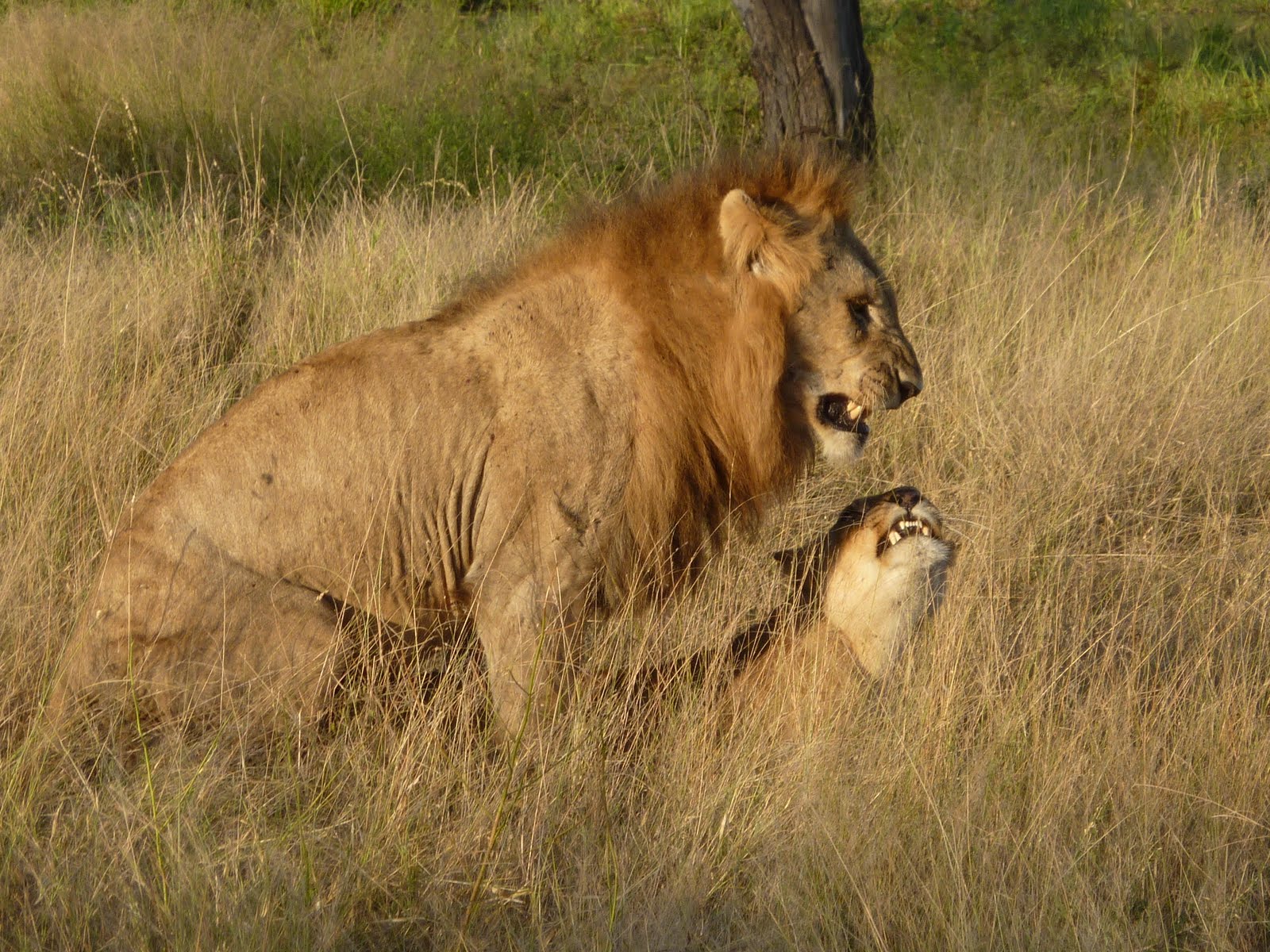
Spotting lions copulating in the bushes is not difficult. While they tryst often, each tryst does not last long. The hard part of catching them in the act is the act itself.

At the Mkaya Reserve in Swaziland, wild nyalas and warthogs walked freely around the camp grounds and rangers took us on walks for close views of rhinos, tsessebes, zebras and giraffes.


As our ranger quickly backed the safari vehicle out of the way, he said, "You'd never want to get between a herd of elephants and their water."

South Africa as a Tourist Destination

South Africa is a beautiful country: spectacular coast lines on eastern and western part of the country that funnel down to the famous Cape of Good Hope; Drakensberg mountain range with peaks higher than 10,000 feet that runs north-south and divides that the country into a wet eastern region and a dry western region; wild game preserves, waterfalls, beaches, breathtaking mountain passes and Cape Town, the crown jewel of South Africa.

The surface area of South Africa is about 10% larger than the combined territory of California and Texas. Officially the population of South Africa at 50 million is about 10 million less than the two states but there could be as much as 10 million unregistered immigrants from other parts of Africa living in South Africa. Even though California and Texas have illegal immigrants residing within their state borders as well, the number is believed to be vastly less than those in South Africa. My observations of the challenges facing South Africa have been discussed in my earlier blog.

On our tour of South Africa, I find Kruger National Park, Mkaya Preserve in the Kingdom of Swaziland, Sani Pass of the Drakensberg Mountain and Cape Town especially memorable and selected photos are presented in this blog. We were in South Africa early March, which was the beginning of autumn, and we experienced ideal weather. The one thundershower that met us as we arrived at the hotel in Drakensberg was impressive by the massiveness of the quick downpour and made us appreciate the clear blue skies that preceded and followed that shower.

Just as I am glad to have visited Tunisia and Egypt when we did, I am appreciative of the natural beauty of South Africa and a bit fearful of its future as a tourist destination. My advice to anyone thinking of visiting South Africa is to do so sooner rather than later.

Rock formations caused by swirling waters on Blyde River.

The three rondavels on the Blyde River Canyon.


The morning mist that envelops the lowveld and Kruger National Park.

Thursday, March 31, 2011

A Brief History of South Africa

As recorded history goes, South Africa is a young country, and that's because the original people, the San (also called Khoisan), had no written language and left only rock art. For centuries, they were protected by an east-west, coast to coast belt of deadly swamp full of malaria bearing mosquitoes, Tse Tse flies and poisonous water that isolated South Africa from the rest of the continent. The eventual southern migration of the Bantus from Central Africa pushed the hunter-gatherer Sans to less desirable land.

The Portuguese were the first white men to land in the Cape Town area on their way to India. Their swords and lances were no match against the greater number of Sans' wooden spears augmented with herds of charging cattle. The heavy casualty suffered at Table Bay (in today’s Cape Town) convinced the Portuguese to keep sailing around the horn of Africa and establish their bases elsewhere.

By the time the Dutch arrived about 150 years later, they had guns and the strength to push their way in. They came to settle and farm and were known as Boers (Dutch for farmers). Together with slaves from other parts of Africa and Far East along with Khoisan and protestant immigrants from France and Germany, they made up the Colored and Afrikaner populations of the Cape Town area of South Africa.

About another 150 years go by (until just before 1800) before the British captured Cape Town to protect the trade route and keep the strategic area out of the French hands. The Boers that did not care for British rule moved out of the Cape Colony toward the interior and came into contact with various tribes of the Bantus that had settled in areas north of the colony.

The fiercest of these was Shaka, king of the Zulus. Ironically he was able to make a technological breakthrough in war craft using iron from the Europeans to devise a short thrusting spear, suitable for repeated thrusts against the enemy and not just one heave and hope for the best. For a brief time, he even held the firearm equipped British soldiers to a standoff.

With the discovery of diamonds (1868) and gold (1886), all hell broke loose. The British had to get their hands on all that wealth from the ground. Some of the biggest diamonds from South Africa literally found their way to the crown jewel collection of the British throne. The British proceeded to fight the Zulus and the Boers to achieve hegemony over South Africa which they eventually accomplished. The different states were consolidated into the Union of South Africa, sometime in the early 20th century.

Seeds of apartheid were already sown by this time as segregation was widely practiced in the urban areas. The de facto practices were steadily formalized into laws and regulations by the white ruling class culminating into official policy of apartheid formed shortly after WWII.

There were two black heroes that wrestled Africa from the white ruling class. One was Robert Mugabe who won control of Rhodesia and turn it into Zimbabwe in 1980 and the other was Nelson Mandela who came to power in South Africa in 1994. Mandela has since stepped out of the limelight and bask in accolades showered on him as a senior statesman. Mugabe, alas, does not know when to retire and has earned worldwide scorn or even worse epithets.

Wednesday, March 23, 2011

The Diversity of South Africa

With the repudiation of apartheid, release of Nelson Mandela from prison and the election of African National Congress (ANC) into power in 1994, South Africa became a democracy governed by the wishes of the majority. The world applauded the selection of Mandela as the first head of the new nation. The successful hosting of the 2010 World Cup seemed to suggest that South Africa is on the way to joining the ranks of fast growing nations such as the BRICs, (Brazil, Russia, India and China).

We spent nearly two and half weeks travelling around South Africa and came away impressed with the tourist potential of this country with its diversity in flora and fauna and in its spectacular scenery. South Africa is also diverse in its people but instead of being a plus, the diversity of people seems to work against the nation than being an advantage. While South Africa has been held up as the standard for other African nations to aspire to, I see troubling signs ahead.

The most obvious is corruption at the top. While still a poor second to the king of Swaziland, who is on to his 14th or 15th wife, President Zuma has announced his intention for take on his fifth, or is it sixth, wife. As our township guide, an ethnic Xhosa, said to us, “As the leader of this nation, he is setting a terrible example for the people.” (Zuma is a Zulu.)

Then there is the leader of the ANC Youth League, Julius Malema, who is merely scary. He struggled through more than the required years to complete eight grades of schooling. He is a fiery orator and self proclaimed admirer of Robert Mugabe and he has been advocating nationalization of the mines. Because as much as 20% or more of South Africa’s black youth have no gainful employment, Malema’s rabble rousing rhetoric finds a receptive audience among the restless youth. Zuma was one time leader of the Youth League and thus Malema could be regarded as a potential future leader of this nation. Needless to say, for a Mugabe-like leader to turn South Africa into another Zimbabwe would be a prospect of enormously frightening proportions.

Some of the policies since the ANC came into power seem to have been taken from Mugabe’s book of governance. For example, we were told that admission to the medical school is strongly biased in favor of the blacks. The minimum entrance test score needed to qualify for admission for the blacks is around 70, but 82 for the colored people and 92 for the whites. One can only shudder at the future of South Africa--where world’s first ever heart transplant was performed--staffed by mediocre doctors that are poorly trained and poorly qualified.

The whites in South Africa are decreasing in absolute numbers and in relative percentage. Some of the whites left South Africa just before the end of apartheid fearing for the uncertainty of the transition. Others have left since the end of apartheid because they now face fewer opportunities under economic policies that are tilted in favor of the black majority. The whites that leave tend to be professionals and thus causing a brain drain. The end of apartheid seems to have been replaced by reverse apartheid.

Corruption by government officials is probably not avoidable but there are two general kinds of corruption. When a government only knows how to line their pockets and does little or next to nothing to develop their domestic economy, those countries are inherently unstable and face occasional uprisings of Egyptian proportions or trudges along in a zombie state where the rich stay very rich and the poor have no hope of a future, not unlike many of the banana republic’s in Latin America.

The South African economy is growing but not fast enough to be considered as a rising economy in the league of BRICs. Furthermore, the rate of growth has been slowing to around 3% per year—not enough to create the number of new jobs necessary to employ a growing population of young blacks and illegal immigrants. Most blacks still live in townships where the school system has been degrading from bad to worse. Most of the young people are not trained for productive work and thus suffers from high unemployment, as high as 30% in places. With so much idle youth, high crime rate is a persistent problem. Without the safety network of state sponsored pension that comes from regular employment, the people in the townships procreate more kids as a form of security in retirement. Thus a downward spiral is formed.

When Mandela first came into power, he declared that no one should live in the dismal hovels found in shanty towns. So far the government has built enough housing for 5 million people, a tiny fraction of the number needed in order to get rid of the shanty towns.

South Africa has a nice highway system. Most of the roads were built during the apartheid rule. For the 2010 world cup, the government built a number of new soccer stadiums. Many have been underutilized since the world cup. The one in Cape Town located in prime real estate has been sitting unused. The local government is said to be considering tearing the new stadium down to save on the annual maintenance cost. Of course, new public works projects create opportunities for graft, which is the biggest driver to spending taxpayers’ money.

Despite its troubles, South Africa is better off than rest of Africa and thus is a magnet for illegal immigrants. The continuous inflow of immigrants adds to the burden of having to provide them with basic services.

South Africa recognizes 11 official languages, English and Afrikaan being two of these. The other nine are languages of the black native tribes dominated by Zulu and Xhosa. Ironically by insisting on each ethnic tribe being allowed to teach in their respective language, it is encouraging de facto segregation and separateness.

Ultimately, the economic well-being of the people of South Africa depends on having good government. By becoming a democracy ruled by the majority does not guarantee good government. Whether South Africa will continue to be the beacon for the continent will depend on the current and next generation of leaders.

Overturning apartheid was South Africa's greatest day in history. Now the leaders will have to deliver for not just the black majority but everyone and put the nation on the path to greatness. The nation may be at a tipping point either leading to economic growth and stability or to disaster. Only time will tell.

=============================================
We were on a tour of South Africa organized by Overseas Adventure Travel. This tour company emphasize discovery and learning as part of the travel experience and made sure that we had a chance to interact with blacks (which represent the majority) as well as the colored segments of the population. We automatically interacted with the whites because our guides were white and so were most of the managers of hotels and restaurants.

Among the dozen travelers in our group, we had two retired professional African American women who were particularly interested in and sensitive to the racial issues of South Africa. They led pointed discussions with our white tour director. Their presence added zest to our discussion, even if we may hold varying views.

A racist could attribute what ails South Africa or even the continent of Africa to race, blaming the supposed inferiority of the black race. The counter to the racist point of view is to argue that educated black leaders such as a Mandela can be as capable and effective as any leader. The crux of the matter is whether black leaders care enough about the population they lead to bring everybody up, to make sure they all get quality education, and to create economic opportunities for all. To the extent they fail to do so, they are reinforcing the biases of racism.

I will write about South Africa as a tourist destination in a future blog.

Wednesday, March 2, 2011

Some People Can't Wait to see the Jasmine Revolution Invade China

One of the first to see the revolt of Tunisia as the beginning of the dominoes that will topple China was Gordon Chang. He suggested that after Tunisia and then Egypt it could be China. He made this bold prognostication on January 30, weeks before Mubarak took the actual tumble.

Mr. Chang, known to boldly sally forth where no real experts would, is famous for his book on the coming collapse of China, which was published in 2001. That China has only more than doubled their economic output and become the second largest economy in the world since the publication of his book does not cramp his style in the least. He continues to hammer on the collapse theme as if constant repetition will eventually make him credible.

Others in the western media are even more "proactive" than Mr. Chang. They are reporting mass unrest and movements of Jasmine proportions in China with sleigh of hand, cut and paste photos. Old photos of mass protest in China against Japan and other equally deceptive file photos became handy tools to illustrate how revolution in China is alleged to look.

The media in the West can get away with such shenanigans in disinformation because they presume that the audience in the west can't tell the difference between a Hong Kong cop, or a Taiwan mass protest or some patriotic movement in China and a disturbance they purport to be reporting. In such cases, photos do lie.

Anyone with a smidgen of understanding about China would realize there is no analogy between what has happened in North Africa to what might happen in China. Yes, there is vast unequal distribution of income in China and yes, corruption and injustice is a major problem. But that is about as far as it goes before the parallel diverges.

The standard of living of the Chinese people has never been better. A great majority of people are satisfied with their lives and the way things are run. Most important, the central government of China far from ignoring the plights of their people actually care and spend a great deal of energy to look after the general population. The leaders of Beijing are sensitive to public opinion and there is no mass feeling of disenfranchisement.

Beware of pundits and their wishful thinking and those desperate enough to fit the facts to their flawed vision.

Thursday, February 17, 2011

Ma Ying-jeou Says “Nihao Dalu

Taiwan President Ma Ying-jeou celebrated the Year of the Rabbit by instructing all government officials to henceforth stop referring the other side of the straits as “China.” He reasoned that to call the other side China was to imply that Taiwan was not part of China, in violation of the 1992 One-China Consensus subscribed by both sides.

Instead, Ma suggested duian (对岸) meaning the shore across the way or dalu (大陆) meaning the mainland when referring to the big neighbor across the straits—akin to the US continent as the mainland to the Hawaiians.

Ma was elected president in 2008 on the pledge of closer economic cooperation with the mainland and reversing his independent minded predecessor’s tension filled approach of “one China and one Taiwan.”

Ma’s popularity initially tumbled as his economic policy did not bring about the immediate miraculous economic recovery that the impatient people of Taiwan expected. Instead Taiwan in 2009 was as much a victim of the global financial meltdown as most other countries.

However, Ma upon taking office began cross strait talks in earnest culminating in the Economic Cooperation Framework Agreement. Even as details of ECFA were being hammered out, direct flights began and economic cooperation flourished.

The payoff became evident in 2010 when Taiwan’s economy grew by nearly 11%, strongest gain since 1986. Export increased by nearly 35%, over two-fifths of which headed to the mainland. Private sector investments in Taiwan increased by nearly one third, an unprecedented show of confidence in Taiwan not seen for more than 40 years.

Tourism from the mainland to Taiwan, not possible under Chen Shui-bian, Ma’s predecessor, has grown to over 100,000 visitors per month and contributed $3 billion to Taiwan’s economy since Ma opened Taiwan to mainland tourists. In less than two years, mainland Chinese visitors have already become the largest source of tourists visiting Taiwan. In addition to tour groups, Ma’s administration is now exploring a way to allow individual tourists in order to tap into even greater tourism spending from across the straits.

By proclaiming appropriate cross-strait terminology, Ma is betting his political future on the presumption that closer economic cooperation with the mainland will continue to pay off. There are plenty of indications that this will be a safe bet.

Despite the fast growing rate of inbound tourists to Taiwan, the frequency of person visits from Taiwan to the mainland, for business and tourism, is still 4-5 times greater than in the other direction. China sends 57.4 million tourists out of China last year and is expected to overtake the US as the largest source of outbound tourists by 2015. Right now Taiwan is only attracting 2 out of every 100 tourists from the mainland and thus has plenty of upside yet to be realized.

Taiwan companies have invested well over $100 billion on the mainland. Mainland companies have only been recently allowed by the Taipei government to invest in Taiwan. This is timely because only in recent 3-4 years are Chinese companies encouraged by Beijing to make outbound investments. The amount invested in Taiwan to date, around $137 million is not even one percent of total outbound investments. The potential of direct investment from the mainland into Taiwan is huge and can only further stimulate Taiwan’s economy.

Ironically when China first opened to the west after 1972, foreign visitors were admonished not to use the term dalu or mainland but China or People Republic of China in order not to suggest separateness between Taiwan and the mainland. Now the use of the term seems to suggest closer cooperation between the two sides.

No one seems to care as to how long the two sides will remain separate or if they will actually reunite. In the meantime, Ma is betting that continued economic improvements in Taiwan will win the peoples’ confidence in him, enough to ensure his reelection.

A version of this piece appeared in the New America Media.

Sunday, January 23, 2011

Building Mutual Trust between US and China has a long way to go

China’s President Hu Jintao has concluded his state visit and returned to Beijing. By most accounts, his visit was considered a virtually unqualified success—for him and for his host, President Barrack Obama—in a rare win-win in the bilateral relations.

The mainstream media considered the visit a win for Obama and his team for successfully presenting all their concerns to Hu: Secretary of State Clinton on North Korea, Treasury Secretary Geithner on the value of the RMB and Commerce Secretary Locke on protection of intellectual property and level procurement policy inside China. Obama in his joint press conference with Hu mentioned his concern on human rights. All the potentially confrontational issues were delivered diplomatically and in easy to digest doses.

Hu’s visit to Congress the day after the state dinner was the most problematic, but the Congressional leaders despite threatening to confront the leader of China had their meetings with Hu behind closed doors. Afterwards they could claim before the press to have raised their concerns with Hu and expressed satisfaction with the outcome.

Hu also won because he got the high profile treatment and honor accorded to him as the head of a major nation and there were no unpleasant surprises or glitches, except for a minor one when everyone expected simultaneous translation at the joint conference and there were none.

The usual China bashing howlers and screechers were kept on the fringe and did not steal the limelight as they might have wished. The confusion at the White House press conference did present Russ Limbaugh the opportunity to make a complete ass of himself on national radio. He broke out with a 20 second verbal burst that sounded like a savage recently descended from the trees. Limbaugh’s infantile braying alleged to imitate Hu’s remarks offended many and did nothing but tarnished his own image.

So is this a new beginning for the US China bilateral relations? I don’t think so. Some fundamental differences between the two sides have not been resolved and until they are, it will be pretty much business as before. The $45 billion of potential export business that Hu’s advance team brought to the US certainly made the whole visit go down more smoothly but does not represent a permanent cure.

How to deal with Taiwan represents by far the most challenging issue facing both sides. In Obama’s remarks at the press conference, he referred to the Taiwan Relations Act, but in the joint statement about the US commitment to one China policy, there were no reference to TRA. Thus, China could claim to have made progress on this issue while the US can claim that nothing has affected the status quo. In fact, until the US renounces selling arms to Taiwan and stops referring to TRA as though it were an international treaty—in fact it was only a Congressional act—progress in the bilateral relations will be sluggish.

The differences are not just on substantive issues but also on style. Both sides need to devote more effort to understand how as well as what messages are being conveyed by the other side.

For example, the media made a fuss about Hu’s public admission that China has more work to be done to improve human rights. In fact, there was nothing remarkable about Hu’s admission. Most officials inside China from local to national level will freely admit that there are plenty to improve about human rights in China.

The media however did not pick up that Hu also said, “The two sides should respect each other’s value systems, beliefs and development models.” In other words, Hu was saying we know we have a human rights problem—so do you America—and we will deal with our problem our way and not according to your standards.

Hu’s speeches were full of references of China looking to be a cooperative partner with the US. He meant a partner in the full sense of the word and not a subordinated party to the US as the big brother. He was looking for mutual respect as well as mutual benefit. Obama’s team of officials seemed to have accorded that sense of mutual respect on this visit.

How Obama was regarded and treated following his visit to Beijing in November 2009 has also been subject to erroneous interpretations by the mainstream media. Because westerner's perspective was based on win-lose confrontation, they thought Obama was too soft and concessionary throughout his visit and did not win China’s respect. They credit the success of this visit to Obama being harder and more assertive. I disagree.

I believe while in Beijing, Obama positively impressed Beijing that he was an American president that China could work with as a collaborative partner. Shortly after his return, however, he announced arms sales to Taiwan which shocked Beijing and they felt betrayed. Obama was oblivious to how Beijing might react. He felt that the US had always sold arms to Taiwan and nothing has changed. China thought that if Obama had considered China a collaborative partner, then he would have taken China’s feelings into consideration and not made a unilateral announcement on a matter most sensitive to Beijing.

This incident did the most damage to the budding feeling of mutual trust that Obama had built while in Beijing. He could have avoided the set back, I believe, if while in Beijing he had privately confided to Hu that because of politics, he would have to sell some arms to Taiwan upon his return and not catch Beijing by surprise.

Mutual trust, much deeper than it exists today, will be required if the US truly wants China’s help in resolving the North Korea crisis, one of the most nettlesome foreign policy issues facing the US. As recent wiki leaks revealed, some Chinese officials have expressed the view that letting the North Korean regime collapse would save Beijing a lot of grief. China has good relations with South Korea and certainly can work with that government as a neighbor once the Korean peninsula is unified.

However, China could not possibly entertain the thought of having American troops stationed on the border of a unified Korea and China. For China to seriously contemplate letting North Korea implode, the US need to assure China that the US would not take advantage of such a collapse and put troops in the north. We would be looking at a lot of mutual trust that does not exist now.

In the past, the US practice of strategic ambiguity meant making conflicting statements and taking inconsistent positions to keep China guessing. Obviously, this did not build trust and did not alter China’s perception of US as unreliable.

To build mutual trust, both sides need to modify their style of communication as well revising their priorities offering selected concessions. The Americans need to improve their ability to receive and digest nuanced signals from China. The Chinese need to be able to communicate in a more direct and straightforward manner so as not be misunderstood.

The day when both parties can feel that there is mutual rapport is when Secretary Gates could say to President Hu upon landing in Beijing, “Gosh, Mr. President I see that I am way off on China’s stealth plane development schedule. If China has been as transparent as I had suggested in the past, I wouldn’t be so embarrassed,” followed by a jocular chuckle shared between friends.

An edited version appeared in New America Media.

Friday, January 21, 2011

Russ Limbaugh, a New All-Time Bottom for America

On national radio program he hosts, Mr. Limbaugh devoted some 20 seconds on nonsensical gibberish that he represented as China's President Hu's comments at the joint White House press conference. His performance lack originality but remind the listeners of many other bigots trying to make fun of the Chinese language. Limbaugh was obviously attempting to demean the Chinese leader and the Chinese language but I don't think he demean anyone more effectively than himself. Just take a listen and you can decide for yourself if he deserves to be considered a national opinion leader. Do you really see an uneducated buffoon like Mr. Limbaugh to be an icon for America? Whatever your political leaning doesn't really matter; wouldn't you be embarassed to be identified as a fellow American of Limbaugh--nay, as a fellow human being?

Friday, January 14, 2011

Diplomatic breakthroughs not likely on Hu's forthcoming visit

If you are expecting diplomatic breakthroughs in the US China bilateral relations associated with China’s President Hu Jintao’s state visit next week, you are likely in for a disappointment.

Up to now both sides are talking past each other and not to each other. It has been a classic case of cultural mismatch and miscommunications--a case of American frontal declarations versus China’s nuanced ambiguous parries. Each side talks but no one appears to be listening to the other.

Officials of Obama’s Administration have been urging China to be transparent and to be more revealing of their intentions. At the same time they have offered China no incentive to go along.

China has been saying you Americans have stealth planes and aircraft carriers and China does not have them yet. America has a nuclear arsenal many times larger. America’s military technology is years ahead and China’s only strategy is to hide behind a cloud of ambiguity. Keeping America guessing is more important to China than to ensure that America can sleep well at night.

Recently, it has been revealed that China will commission its first carrier this summer and has been testing missiles capable of hitting a moving target thousands of miles away, in other words a “carrier killer.” The US DOD is naturally upset. Up to now, the waters of the Pacific up to China’s shore have been American navy’s own backyard, uncontested by any other power.

In advance of Secretary Robert Gates visit to China, Pentagon presented a laundry list of topics he wished to discuss. When he got to Beijing, China welcomed him with the first test flight of their version of the stealth fighter. When he asked about the timing, President Hu assured him that it was purely coincidental. Sure it was, just like years ago when a Chinese submarine came up to surface within hailing distance of Kitty Hawk, the American carrier patrolling the Pacific.

Before Gates left Washington for Beijing he had said that he hope to convince China to abandon development of advanced weapon systems that would threaten American superiority and furthermore he did not expect the Chinese stealth plane to be operational before 2020. Maybe China begs to differ?

On the one hand, Gates would like to begin high level dialogue between the military counterparts of both sides. On the other, Gates did nothing to assure China that the US holds no hostile intentions towards China—especially not after he then stopped in Japan and urged Japan to place orders for America’s advance fighters in order to keep pace with China’s stealth fighters, ones that he thought wouldn’t be operational for another decade.

In Beijing, Gates wanted to talk about nuclear non-proliferation, missile defense, cyber security, space cooperation, united position on North Korea and Iran, to name a few. His host and counterpart, General Liang’s reply was simply no more arms sales to Taiwan.

What General Liang meant was that China considers Taiwan as part of China and American sales of arms to Taiwan is in violation of China’s sovereignty. If the US is willing to recognize China’s strategic interest and not hide behind Taiwan Relations Act, a unilateral act of America’s making, and then everything else can be on the table.

Shortly after Secretary Gates returned, Treasury Secretary Geithner listed economic and commercial issues that need to be resolved when President Hu come visiting. In exchange for concessions from China, Geithner offered a curious incentive, namely the ability for China to buy more high technology products from the US. Basically Geithner was saying, “Give us what we want and we’ll let you buy more from us.” It’s not clear whether Geithner was talking for the benefit of the Chinese advance team or to cater to expectations of the home audience.

The greatest disconnect seems to be the US insistence of being the only remaining super power with all the privileges pertaining thereof, namely play by American rules. China is saying while we have no desire to be a competing power, we want to be treated with respect and as a peer.

The American doctrine of trust us, we have nothing but good intentions may play well elsewhere but not with China. China does not see American actions consistent with stated intentions, only veiled threats if China does not comply.

I was in Beijing last month as part of a delegation from The Committee of 100, meeting with leaders of Beijing. At the briefing held with American officials at the new US Embassy, I asked if we have an official or unofficial policy of containment of China. The startled official burst out laughing and said, “Absolutely not.”

Later in the afternoon, we went to China’s Ministry of Foreign Affairs and I had the opportunity to pop the same question, namely does China believe the US is trying to contain China. Our host, a Vice Minister, replied, “No, we don’t believe so and even if the US wanted to, we don’t think it could be done.”

At least America’s frontline diplomats working in China see and understand that we are dealing with a China with a new attitude and confidence. It behooves Washington to adjust as well.

China will have its blue water navy and space warfare capability because China can afford to develop them. By having counter punching capability, China may actually be more willing to examine America’s stated altruistic intentions.

If America continues on business as usual basis, it will use China’s every advance in military technology as provocation and justification for increased defense spending. For every dollar China spends on military, America will have to spend 5 to 10 to maintain its overwhelming edge. America will be using the Reagan strategy deployed effectively against the former Soviet Union on itself. America will end up with a national budget for defense and nothing else, which is what led to the implosion of USSR.

Or, Washington can begin to face reality and see our own limitations. America’s already mighty military does not have to get mightier. China is not buying America’s idea of strategic ambiguity consisting of conflicting messages. China’s stated desire is to be a partner with the US and America needs to figure out what concessions—and not just feel good declarations--to give to make friends with China.

Washington needs to convert the mindset of regarding China as a rival into a potential ally. This is not going to happen by the time of Hu’s visit.

Also posted on New America Media.

Thursday, December 23, 2010

When it works for the West, it's free market economics

When it works for Asian countries, it's state controlled capitalism. This is just one of the scathing observations by John Cassidy written in the guise of book reviews in December 13, 2010 issue of the New Yorker.

Didn't UK and later the US rise to great economic power on the backs of free trade? Nonsense, Cassidy said. UK used gunboat diplomacy to force China to accept opium import in order for Britain to erase it's bilateral trade deficit. UK used tariffs as trade barrier to protect it's home grown industries until they were able to compete internationally.

The US economic policies followed UK. From Alexander Hamilton to Abraham Lincoln, the US used high import duties to protect domestic industries. Even today, selected American agricultural products are protected by tariffs and subsidies.

"Not one of today's economic powers practiced free trade during its developmental stage," Cassidy observed in his piece.

Some other quotations from Cassidy's piece are excerpted below:

"Compared with these naked exercises in industrial policy (by western powers), some of the Chinese infractions that have most exercised the W.T.O. seemed relatively minor."

"Part of the evidence he (referring to author Halper*) presents for China's malign influence is the fact that it helped build a hospital, an irrigation project and a vocational training center in Ghana--a multiparty democracy that, mystifyingly, is on his list of repressive African regimes."

"The heavy hand of American demostic and foreign policy in shaping economic outcomes tends to get ignored in current policy debates.."

"Western governments have used the methods of state capitalism for hundreds of years in their bid to shape the world around them....The idea that market forces alone led to the West's success is nonsense." This quote Cassidy attributes to chief economist of HSBC.

Cassidy's concluding remark: "The greatest danger that Western prosperity now faces isn't posed by any Beijing consensus; it's posed by the myth of the free market."
________________________

*Halper's book reviewed by Cassidy was "The Beijing Consensus: How China's Authoritarian Model Will Dominate the Twenty-first Century."

Saturday, November 20, 2010

Why not Let President Obama Collect the Peace Prize?

The Norwegian Nobel Peace Prize Committee is worried. What if they throw a celebration and Liu Xiaobo, the honoree, can't attend? He is in jail. The Chinese authorities apparently won't let his wife attend in his place, nor apparently any of his friends will accept in his place. So what to do?

I recommend asking President Obama to attend and accept on Liu's behalf. Why not? The Committee gave Obama the Prize last year, somewhat prematurely one might say, and what has he done for World Peace?

American soldiers are still fighting in Afghanistan and Iraq with no end in sight. One would be hard put to point the finger at any one spot on earth where his administration has been able to lower tension rather than raising the temperature.

Since President Obama has rendered the previously award rather pointless, adding another won't matter.

Like the Committee, I had harbored fond hopes that the election of Obama meant a different America. Unfortunately, he and his administration has not been able to break from the past.

The neoconpoop* mentality held over from the Bush Administration continue to dictate the foreign policy thinking of the current one. In other words, we still think of ourselves as the self-annointed champion of democracy and supreme ruler of the world.

In the meantime, our federal budget is bleeding red ink and our young men and women bleeding real blood. Increasing number of our allies dare to disagree with our views and are pulling out of troubled spots and leaving behind the Americans with perhaps a handful of Brits to put out the fires.

Obama's opposition fresh from electoral victories big and small has avowed that their top priority is to make sure Obama does not get re-elected in 2012. No one seems to care about getting anything done in the meantime that would rectify many of America's pressing afflictions.

Obama's recent trip to Asia did not accomplish much nor cover him with glory. He certainly can expect to do better with a quick swing to Oslo. Since he won't have to take along a huge entourage, the trip won't give cause for his opponents to make astronomical exaggeration of the bill to taxpayers.

And the Norwegians can still have their party, even with a familiar name brand.
---------------------------------------------
* neoconpoop is abbreviation for neoconservative nincompoop.

Thursday, November 11, 2010

The Diaoyu Controversy Festers

Since the Chinese fishing trawler collided with Japanese Coast Guard vessel off the Diaoyu islands, the crew was detained, the captain arrested, China protested then tourism to Japan dried up and rare earth exports halted and finally the captain was released without charges. However, the bilateral tension and dispute continues today.

A recently released video clip taken from the coast guard ship strongly suggested that the ship swerved in front of the trawler in an attempt to stop the forward motion of the fishing boat. Since two objects cannot occupy the same space, the collision became inevitable. Claiming that Chinese trawler deliberately rammed the coast guard vessels seemed a bit of a stretch.

A more enlightened summary of the incident and dispute has been written by Professor Jerome Cohen in the Council of Foreign Affairs. It is recommended reading for those interested in the history behind the dispute.

Wednesday, November 3, 2010

Sure way to win in politics: Blame it on China

America is abuzz over the TV commercial running on national networks by Citizens Against Government Waste (CAGW). In an ominous ad projected into 2030 and in a style reminiscent of Apple’s sledgehammer Super Bowl ad, the message is saying that federal government debt and waste is killing this country.

But the most obvious villains in the piece are not the Americans responsible for the mess but the dastardly Chinese. In 2030, the Chinese listening to the lecture in this commercial are chortling in delight at America as the most recent failed state to enter the trash bin of history joining the British Empire, Rome and Greece.

Actually, I have also reached the same conclusion that America is approaching that of a failed state. I just wasn’t smart enough to connect the dots and put the blame on China.

I see politicians lack the courage to tell the unpleasant truths that cutting taxes is no sure cure to economic revival, that continuous warfare in Afghanistan and Iraq is bringing America to ruin, and that allowing the Ponzi schemes on Wall Street to multiply and get too big to fail is destroying the credibility of the dollar.

I don’t see our leaders prescribing actions for the benefit of our country. I see the policy makers piling on national debt to be paid by future generations. By making the dollar worth less with time, I believe they are hoping to pay the mounting national debt with cheaper dollars. Shame on them if that’s what they are thinking.

A guest on NPR estimated that over $4 billion will be spent on campaign financing for this off year election, a ghastly increase of around 35% over the total spent for the last presidential election. Issues have been tossed aside in favor of 15-second, attack sound bites cloaked in half truths and outright lies financed by hidden donors.

The way to win elections is to raise overwhelming lot of money and fill the air with negative and even hateful messages and hope that enough sticks to tar the opposing candidate and carry the day. America is now a model of sham-o-cracy, not democracy.

In a Fox interview following the repeated airing of the CAGW ad, Donald Trump declared, “This country is in serious trouble.” I heartily agree. But then he goes on to say, “The Chinese are making everything. They are smart and they are cunning.”

The Fox anchor proceeded to gush to Mr. Trump in admiration, “Sounds like you are getting ready to run for president.”

Wow. This country is in even more trouble than I thought. Just think, all our troubles will go away if we just blame the Chinese. Blame them loud enough and one can even sound presidential. If I were the Chinese, I wouldn’t wait till 2030, but would unload the trillion dollars they are holding now.

A version appeared in New America Media.

Sunday, October 3, 2010

Domestic Politics Hurting Relations with China

As Congress approaches the midterm election, China-bashing has once again proven to be the convenient wool to pull over the voters’ eyes. It is, after all, easier to put the blame on China than explain to voters why America is still in the doldrums.

The House of Representatives seems determined to label China a currency manipulator and enact a law that would force the Obama administration to impose a countervailing duty on goods from China to adjust for the perceived undervaluation of the renminbi. So far, no one in the bipartisan effort has seen fit to explain how to calculate the alleged undervaluation.

Not even a Nobel Prize–winning economist has been able to present a case to prove how making imports more expensive to the American consumer would create more jobs for America. The last time the United States pressured China to take the yuan off the peg, the currency appreciated more than 20 percent against the dollar and, perhaps to the lawmakers’ surprise, the trade imbalance didn’t shrink but widened by about the same relative amount.

Premier Wen Jiabao, in his speech in New York before attending the UN General Assembly meeting, declared that the value of the yuan could not be responsible for the subprime mortgage scandal that led to the financial meltdown and the resulting record budget deficit and national debt. He suggested that Congress should be addressing the real root of the problems of America’s economy rather than distracting America’s attention by picking a fight with China.

It’s universally accepted that the protectionist Smoot Hawley Tariff Act did nothing to pull America out of the Great Depression but only made matters worse. Surely, some of the politicians on Capitol Hill must know that protectionism is the road to a lose-lose outcome. Most probably, the House is counting on the Senate or the Obama administration to not let the charade go too far.

On the other hand, instead of politics as usual, our elected officials could devote their energy to doing what they have been elected to do—namely, to think about and solve the many real problems confronting America.

For example, no one has the courage to ask: How can we balance the budget if we don’t raise taxes but continue to spend like we have with no worries instead of sitting on a record budget deficit?

How can we reverse the downward spiral of the value of the dollar if all we are doing is piling on our national debt?

No one is asking why our economic stimulus package doesn’t seem to work and is not creating jobs. Is it because too much was allocated to bailing out car companies and banks deemed too big to fail?

Why do we continue to act like the world’s only superpower when Iraq and Afghanistan are bleeding America into potentially fatal state of anemia?

Why does it take a comedian to point out to Congress that hating illegal aliens is contrary to our desire for affordable fruits and vegetables?

Our leaders continue to pat themselves on the back, expressing pride that our outstanding colleges and universities are world class, yet seem oblivious that these institutions depend on foreign students to maintain their excellence. Why are they not doing something about improving the quality of K-12 education in America?

Chinese cuisine has a delicacy called “fried live fish.” The head of the live fish is held out of boiling oil while the rest of its body is fried to a crisp. When served on a plate, the cooked body is covered in a sauce while the head is still alive and gasping for air. Sad to say, this dish is an appropriate metaphor for our Congress.

China’s options and leverage to counter Congress are complicated and difficult. Of the hard currency reserve China is holding, more than 1.5 trillion are estimated to be in dollars. Any retaliation that would materially weaken the value of the dollar would not be in China’s interest.

China is already America’s second-largest export market and growing faster than China’s export to America. Obama’s recent announced intention to reform the export control process will boost high-tech sales and add to the momentum. China could halt imports from the United States, but its vested interest is in a stronger U.S. economy, not a weaker one.

The Chinese embassy spokesperson in Washington, Xie Feng, has just publicly confirmed that China’s President Hu Jintao has accepted President Obama’s invitation and will visit the United States in January. He added that China considers this visit to be the highest national priority.

Xie also indicated that both sides—meaning Beijing and the Obama administration—expressed confidence that all the thorny issues facing the bilateral relations can be worked out.

Given Congress's determination to sidetrack the relations, there is always a chance that the January visit will be postponed or cancelled. Or worse, Washington could force Beijing’s hand into making a mutually destructive move in order to get America to focus on the real issues.

This version appeared in New America Media on October 1, 2010

Sunday, September 26, 2010

Is Congress working on behalf of America's Interest?

As Congress approaches the mid-term election, China bashing has once again proven to be the convenient wool to pull over the voters’ eyes. This time around, Japan got in the act first by literally bashing a Chinese fishing vessel to roil the international waters.

The House of Representatives seems determined to label China a currency manipulator and enact a law that would force the Obama administration to impose a countervailing duty on goods from China to adjust for the perceived undervaluation of the renminbi. So far no one in the bi-partisan effort has seen fit to explain how to calculate the alleged undervaluation.

No one, not even a Nobel Prize winning economist, has presented a case as to how making imports more expensive to the American consumer would create more jobs for America. The last time the US pressured China to take the yuan off the peg, it appreciated over 20% against the dollar and to the law makers’ surprise the trade imbalance didn’t shrink but widened by about the same relative amount.

Premier Wen Jiabao in his speech in New York before attending the UN General Assembly meeting declared that the value of the yuan could not be responsible for the sub-prime mortgage scandal that led to the financial meltdown and the resulting record budget deficit and national debt. He suggested that Congress should be addressing the real root of the problems of America’s economy rather than distracting America’s attention by picking a fight with China.

About three weeks ago there was a collision between a fishing trawler from China and two Japanese naval vessels near the uninhabited but disputed islands off the coast of Taiwan. The Chinese call the islands Diaoyu while Japan called them Senkaku.

China has claimed sovereignty over these islands as part of Taiwan for centuries. Japan came into control of these islands when the US handed them over to Japan along with Okinawa and the rest of Ryukyu chain of islands in 1972.

At the time, mainland China and Taiwan were hostile adversaries not on speaking terms and were not in a position to protest America’s unilateral action. China contends to this day that the islands should have reverted to China after World War II when Taiwan was returned to China.

Since 1972, Japanese patrol boats would periodically interfere with fishing boats from the mainland and Taiwan. Noisy protest from the Chinese in China, Hong Kong, Taiwan and overseas Chinese communities would invariably follow such acts by the Japanese navy. In 1996, David Chan, a Hong Kong activist, tragically drowned while attempting to make a point by swimming to one of the islands.

Contrary to the western media’s notion that conflicting interests in these uninhabited islands stem from possible oil deposits beneath the sea, the feelings of the Chinese are rooted in nationalism based on history and full of passion.

The latest incident raised the bilateral tension to new heights when the Japanese coast guard seized the fishing boat and took the crew into custody. Japan’s action immediately caused protests with increasing stridency as the trawler and crew was held. They were released about a week after the incident but the captain remained in captivity for 17 days before he was let go.

The only explanation offered for this provocative action attributes domestic politics within Japan—an election was going on--as the cause. Beijing repeatedly called in the Japanese ambassador to lodge protest in strongest terms, but Japan insisted that they would charge the captain under Japan’s domestic laws.

Japan finally dropped charges and released the captain after China nipped the tourism bloom in Japan by discouraging travel to Japan and stopped export shipments of rare earth minerals critical to Japan’s electronic industry.

China’s options and leverage to counter US are far more complicated and difficult. Of the hard currency reserve China is holding, more than 1.5 trillion are estimated to be in dollars. Any retaliation that would materially weaken the value of the dollar would not be in China’s interest.

China is already America’s second largest export market. Obama’s recent announced intention to reform the export control process will boost high tech sales and add to the momentum. China could halt imports from the US but China’s vested interest is in a stronger US economy not a weaker one.

The Chinese embassy spokesperson in Washington, Xie Feng, has just publicly confirmed that China’s President Hu Jintao has accepted President Obama’s invitation and will visit the US in January. He added that China considers this visit to be the highest national priority.

Xie also indicated that both sides—meaning Beijing and Obama Administration--expressed confidence that all the thorny issues facing the bilateral relations can be worked out.

Given the Congressional determination to sidetrack the relations, there is always a chance that the January visit will be postponed or cancelled. Or worse, Washington could force Beijing’s hand into making a mutually destructive move in order to get America to focus on the real issues.

Wednesday, September 8, 2010

Obama Delivers on Export Control Reform

The White House recently announced its intention to fundamentally reform the US export control process. This overhaul has been long overdue and will have significant impact on the American economy particularly in Silicon Valley, strengthen US China bilateral relations and simplify the lives of ethnic Chinese professionals working in high tech industry.

As the announcement said, “The current export control system is overly complicated, contains too many redundancies, and, in trying to protect too much, diminishes our ability to focus our efforts on the most critical national security priorities.” Amen. Those of us working in the high tech companies have been saying that, probably in more pungent terms, for decades.

The reform if implemented as announced will greatly simplify the licensing procedure. By strictly defining those items that are subject to control and eliminating multiple and often conflicting agencies, the new policy should render export license application transparent and take away the pain of exporting.

The White House release cited the brake pads for the M1A1 tank as one example of what ails the current export control practice. Same degree of control is applied to the export of the brake pads as it is for the entire tank. Yet the same brake pad is used in fire trucks which can be exported without control. This is the kind of regulatory contradiction the reform hopes to remove.

While the announced intent for export control reform is in general terms and not specifically addressing exports to China, it will have the greatest impact on trade with China. Heretofore, China has been placed in not outright foe and not exactly friend category--which means even export of heavy duty brake pads, in the aforementioned example, is subject to intense scrutiny as regulators examine the likely “dual use” nature of the export sale. Dual use is bureaucratic speak of items for civilian use that could have military application as well, and thus need to tie red tape around the transaction.

China is potentially America’s biggest customer for high tech export. Because of the ambiguity of prevailing export control policy, much of the potential has not been realized. Instead, China buys from Western European countries and Japan because they do share the same concern as the US.

Obama’s intention is good news for Silicon Valley—and other high tech regions—as these companies can now concentrate more on exporting and less energy on walking through the labyrinth of government approval.

This development should also be good news for Chinese Americans working in the high tech industry. Since China has become a major buyer, many of the Silicon Valley companies have wisely employed ethnic Chinese in their firm to engage in marketing and sales to China. Such occupation carried unexpected hazards.

Silicon Valley has witnessed cases where the export manager to China landed in jail for alleged sale of dual use items to China. In one case, it involved the sale of shaker tables. The government accused the ethnic Chinese export manager of selling to a missile making facility in China rather than the locomotive factory stated in the application. By the time the government dropped the charges for lack of substantiation, the ex-export manager had been out of a job for months and confronted with the reality of a ruined career.

With the new regulations, such ambiguity should not happen again and exporting to China no longer a cause for racial profiling.

The export control reform, while long overdue, will be an all around win. We can only hope that politics do not interfere.
--------------------
A similar commentary was posted on New America Media.

Wednesday, September 1, 2010

Don't Miss this Documentary on WWII History, Part 2

Last month, China’s CCTV presented a fascinating 12-part documentary series on a part of WWII not particularly well known in the West--namely, the Burma Theater. The presentation was in English, very factual and professionally done, absent of any propaganda. The program gave impartial rendering of the roles of Chiang Kai-shek, General Joe Stillwell, General Sun Liren and many others. In the second half of this series, the atrocities of the Japanese soldiers were graphically described.

Episode 6, Pincer Movement – In this episode, the Chinese troops from India entered Burma and mounted a large scale offensive and scored a major victory. They over ran Japanese division command headquarters, and the Japanese incurred heavy casualties, more than twice as many as the Chinese side. This is unprecedented up to now. Chinese success can be attributed to better trained and better equipped soldiers. Just as critical was American air support. American planes provide air cover, detailed maps of the terrain via recon flights and timely drops of arms and supplies.

Episode 7, Victory at Myitkyina – While the battle in episode 6 was going on, General Stillwell conceived of a brilliant surprise attack to capture a strategic airfield at Myitkyina. The capture of the airfield would enable the Allies to fly in troops to the front line of battle. The surprise attack was successful but unfortunately the commanding General Frank Merrill (of the famed Merrill Marauders) made a terrible decision not to press on and take the town while the Allies had overwhelming numerical advantage and thus allowed the Japanese to send in reinforcements. It then took the Chinese troops another two months at great cost in casualty to finally capture the town of Myitkyina. This victory at Myitkyina marked the beginning of the end of the Japanese in Burma.

Episode 8, Stalemate at Nujiang River – While previous two episodes described the successes of forces under Stillwell’s command, this episode talked about the stalemate in southwestern Yunnan where the Japanese forces held on to the west bank while the Chinese were in the east bank. This stalemate lasted for two years. During this time, the Japanese troops committed all forms of atrocities against the local people in their territory. Besides usual gang rape of women, random killing and bayoneting, a particularly gruesome practice was described. The soldiers would bend a tall bamboo sapling and tied the entrails from the rectum of the victim and then watched in great entertainment when the bamboo snapped back and dangled the victim by the stretched out intestines. These activities were a deliberate attempt to dehumanize the Japanese soldiers so that they could become unfeeling fighting machine. Each soldier were given two coupons per week that entitled them to the services of comfort woman. The comfort women, mostly from the local villages, did not even have time to eat but must eat while servicing their clients. After the Americans re-equipped the Chinese, FDR began to push for offensive against the Japanese across the river. CKS reluctantly agreed but by then, in April of 1944, the rainy season was upon them.

Episode 9, Battle of Gaoligong Shan – Commander of the Yunnan based Chinese troops was General Wei Lihuang. He devised a pincer surprise attack on the Japanese via a small mountainous road, not used in generations. Alas his plans fell into Japanese hands and they were dug in and prepared. A bitter hard fought battle ensued. The difference that turned the tide was the minority people of those mountains. They willingly fought alongside, provided food and supplies and as porters for the supplies. The Japanese had no local support and were cut off. Afterwards, the Chinese found plenty of evidence that the Japanese resorted to eating human flesh, smoked, boiled and dried. They even found evidence of Japanese soldiers trapped in pillboxes having to eat the flesh of their fallen comrades.

Episode 10, Battle of Songshan – Having encountered heavy resistance in Gaoligong, General Wei and his staff changed their plans and moved their troops southward to attack Songshan, the highest point that looks down the Yunnan Burma Road. Again their intelligence proved faulty and the Chinese encountered heavy resistance from far more troops than anticipated. It took three months of hard fighting and a casualty of 7000 to finally secure the top of Songshan and about 1000 Japanese dead.

Episode 11, Capture of Tengchong – Capture of Tengchong was crucial to the allied plans to re-open the Burma Road and join forces with the Chinese troops from India. The capture did not come easy. The walls of Tengchong could not be breeched by regular gun fire. It took American bomber planes many runs to create openings for the Chinese soldiers. The wall was built during the Ming dynasty made from volcanic rocks.

Episode 12, Battle of Longling – Concurrent with the battles of Songshan and Tengchong, another part of the Expeditionary Forces were dispatched to capture Longling. Longling sat at the junction of the Yunnan Burma Road and the road to India and its capture would mean the reopening of the lifeline to China. The battle took 4 months and three major offensives before the Japanese troops were pounded into submission and totally annihilated. The victory was complete when the forces then moved south to Burma and joined the Chinese forces from India. January 1945 marked the end of Japan’s influence in Southeast Asia. The Chinese sent forces into Burma in 1942 and again in 1945 at great cost suffering casualty of nearly 100,000. They could not have won without the air cover provided by the American Air Force and the heavy artillery supplied by the Americans.

It was one of the highlights of US-China bilateral colloboration in WWII.

Monday, August 30, 2010

Don't Miss this Documentary on WWII History, Part 1

This month, China’s CCTV presented a fascinating 12-part documentary series on a part of WWII not particularly well known in the West--namely, the Burma Theater. The presentation was in English, very factual and professionally done, absent of any propaganda. The program gave impartial rendering of the roles of Chiang Kai-shek, General Joe Stillwell, General Sun Liren and many others. The one nation that did not come out very well was UK. They were portrayed as arrogant, treacherous and had no stomach for battle.

Episode 1, Arduous expedition – By 1941, the Burma Road was the only lifeline to the outside world remaining for China. CKS recognized the strategic importance and sent an expeditionary troops of 100,000 to fight alongside the British. Undermanned and underequipped, the troops fought the Japanese to a standstill for 12 days at Toungoo until the Brits unilaterally withdrew, thus exposing the flanks to the Japanese and leaving the Chinese surrounded and cut-off. The Chinese under the command of Dai Anlan managed an orderly withdraw with a casualty of under 2000 compared to 5000 of the Japanese. The Japanese occupied an empty town and the Japanese general ordered the burial of all the Chinese dead with honors for their bravery.

Episode 2, Rescuing the Brits – The Brits plus the Chinese soldiers had the Japanese outnumbered, but the Brits ran until they were trapped by a pincer movement and it remained for the Chinese to come to their rescue again. About 800 of Sun Liren’s crack troops rescued the 7000 British troops, dying because of lack of drinking water. For this act of bravery, General Sun was awarded the medal of the highest honor by the British government. The actual general in command was Liu Fangwu who was to go unrecognized until much later when Margaret Thatcher visited the U.S. and personally thanked him. Despite this rescue, The Brits still had their own agenda which was not to defend Burma. They withdrew towards India without telling the Chinese and blew the Mandalay Bridge behind them and thus cut off the Chinese retreat back to China. The Chinese was to pay dearly when the Japanese used stealth to go behind the Chinese and cut off their retreat to China.

Episode 3, Ordeal on Savage Mountain – While the Brits withdrew to India, CKS did not want the Chinese to follow suit for fear of losing the command to the Brits. Du Yuming obeyed and order his command to retreat northward across primordial forest called Savage Mountain (野人山) where most his troops were decimated by disease and starvation. A fallen soldier was nearly instantly turned into skeletons by leeches, ants and others that crawl in the jungles. The 200th Division commanded by Dai fought rear guard action and were the last to leave. Dai was wounded and died and his body was carried all the way back to China by his followers. Sun Liren did not heed Du’s orders, reasoning the primordial forest was deadly to his troops. Instead his troops marched southward, caught the Japanese by surprise and broke through and then headed westward into India. The Brit commanding general ordered Sun’s troops to stand down and disarm at the border. Sun threaten to fight into India. Just in time, the general of the Brit troops rescued in Burma rushed to see the commanding general to tell him that his British troops were no match for Sun’s and it was no way to pay back for the heroic rescue. Of the 100,000 Chinese troops sent into Burma, only about 30,000 survived.

Episode 4, Recuperating in India – Sun’s 38th Division virtually intact became the core fighting force resting in Ramgarh. The remnants of 22nd Division that straggled out of Savage Mountain joined. General Stillwell finally had an opportunity to build a fighting force directly under his command and he equipped and trained the two divisions with the best weaponry possible. Sun also asked CKS to send him new recruits to fill the ranks of his army and CKS responded by sending patriotic students as recruits. The British was responsible for provisioning the troops. For the first time, the Chinese soldiers had two sets of boots, two underwear, two pairs of thick socks and two pairs of thin socks, etc. Sun with the help of American trainers taught his troops not only how to fight, but how to swim with pack, to climb mountain and walk in jungles. He was getting the two divisions ready to engage the Japanese with trained and toughened soldiers better equipped to fight than the Japanese. The American objective in Burma was to tied down the Japanese troops, the Chinese to keep the lifeline open while the Brits had interest in Burma only to the extent it would keep the Japanese from invading India.

Episode 5, Counter attack begins – Finally the counter attack by the Chinese troops from India to northern Burma began in this episode. The Chinese soldiers were entirely different from those that fought earlier when they along with the Brits were defeated by the Japanese and had to retreat to India. These were physically fit, well trained and well equipped. This was the beginning of the turning of the tide. They were to face the crack Japanese troops that fought in Shanghai, participated in the Nanking massacre and occupied Singapore despite greatly outnumbered by the British troops stationed there, troops that had no stomach for fighting. At the Cairo Conference CKS thought he got Churchill's agreement to commit the British troops to the joint counter attack. Few days later, Churchill reneged and decided not to join in the battle.

Saturday, July 31, 2010

Bill Richardson Makes Important Decision

Governor of state of New Mexico is deliberating on whether to posthumously pardon Billy the Kid, some 130 years after he was gunned down as an outlaw.

One would have to admire Governor Bill Richardson for his willingness to tackle such a weighty issue and one would likely jump to the conclusion that unlike its neighbors, all must be well in New Mexico.

Unlike Arizona, New Mexico must not have any conflict over illegal immigrants.

Unlike Nevada, Richardson’s state must be enjoying robust employment.

Unlike California, he must not have to wrestle with budget deficits.

And for sure unlike the rest of the country, New Mexico’s school system must be doing just fine and leaving no child behind.

Hard to know how the people of New Mexico feel about their governor, but surely William Bonney is rolling over in his grave in gratitude.

Sunday, July 11, 2010

Borobudur near Yogyakarta, Indonesia

Four days in Yogyakarta (Yogya for short and first y is pronounced as a j) were enough to form some impressions about Indonesia. The roads we traveled on were by and large in good shape though some in the countryside can be quite narrow and for this reason favored smaller, narrower foot print cars. Especially in the city, the streets swarmed with motorbikes. I guessed that for every car, there might be 10 mopeds and the like but our guide thought the ratio was closer to 25 to 1. Most of the scooters and mopeds looked less than 3 years old, perhaps an indicator of the recent improvements in the Indonesian economy. Most people, particularly in the city, wore helmets when they rode or drove the motor bikes. Ironically, young children rode sandwiched between their parents and usually were without helmets.

Despite varying degrees of aggressiveness among the drivers, the traffic was fairly orderly. We did not witness any road rage or arguments and did not see any traffic collisions. In general the people were friendly to each other and to foreign visitors. I believe the gentleness of Javanese culture fosters harmony among the people far more successfully than say the Chinese culture has.

It’s no surprise that Indonesia, being a nation of archipelagoes, has many ethnic people and many local languages. Bahasa is the national language that was created in the 1930’s by revolutionaries as part of the attempt to unify the chain of islands that was to become the nation of Indonesia. The language apparently borrowed a lot from the Dutch and looked easy to learn. Some words were naturally intuitive such as gratis, polisi (police), taksi (taxi), apotek (pharmacy). Other words, we saw so often that we can figured out what they meant, for example, masuk (enter) and keluar (exit), nasi goreng for fried rice and mie goreng for chow mein.

Day 1

We left Singapore in the midst of a huge tropical storm. The Air Asia flight was only a few minutes late. Yogyakarta airport did not have gates that connect directly to the terminal but we alit on the tarmac and walked into a small entry to go through immigration. Buying the visa on arrival was actually a shorter line than the line for foreigners carrying passports with visas already in them. On the spot tourist visa at $25 per person was also cheaper than getting it ahead of time in America. Mr. Herry, our guide, was late getting to the airport so that a momentary panic was creeping in when he showed up. I had just gotten a new HTC Droid phone and did not really know how to use it yet and was trying to call Mr. Herry when he appeared.

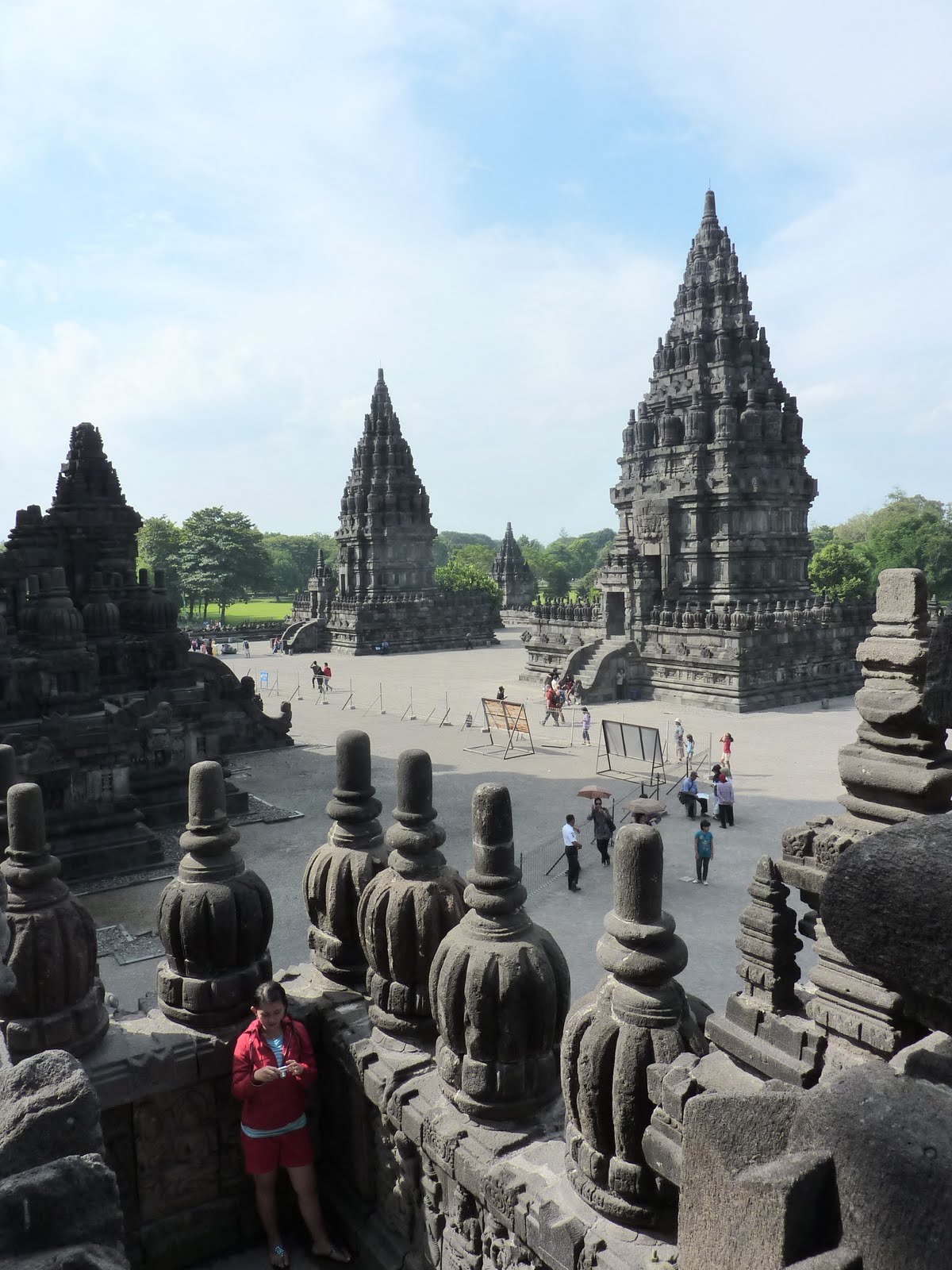
Prambanan temple complex was located near the airport, both east of Yogya. The temple complex was restored from rubble of gray volcanic rocks that we were to see a lot of during this visit. Volcanic rocks being the most available were used to erect temples, unfortunately without any binders. The tongue and groove method of constructions proved unable to resist the shaking from the movement of the faults over the centuries. While the volcanoes provided the building material, the earthquakes destroyed the man-made structures leaving piles of rocks for puzzle loving archeologists to solve.

From Prambanan, we headed west into the city of Yogyakarta to the Phoenix Hotel. Phoenix was located near the center of town but not in a very interesting neighborhood. The hotel itself was interesting from an architecture point of view, converted from a previous British estate.

Day 2

We got up at 3:30 AM in order to be picked up at 4 to see the sunrise at Borobudur. The sunrise tour was available exclusively through the Manohara Resort Hotel situated next to the site. The tour included a give-away flashlight for each person and tea or coffee with pastries afterwards. We could have selected a tour that included staying at the Manohara and sleep an hour longer. The other advantage was that the temple was just a short walk away and hotel guests could then go to the Borobudur at any time at no extra admission charge. For anyone thinking of seeing only Borobudur and not stay in the area for more than 2 nights, Manohara would have been an appealing option.

We were not rewarded with a spectacular sunrise as we took the dawn trek up the terraced temple site but we did enjoy the serenity of the morning calm undisturbed by any throng of noisy tourists—which we were to meet on our way down. From the top of Borobudur, we watched the post-dawn fog rolled into the valley providing a veil over the hillside and the light from the sun behind the clouds gradually giving definition to sculptures of sitting Buddha in various poses of meditation. On our descent, we made partial circles of each terrace to enjoy the artistry of sculptured stone panels. On the very bottom terrace, Mr. Herry told us to go clockwise from the east gate to see the beginning-to-end portrayal of Ramayana, the classic Hindu epic of good vs. evil, abduction and rescue, heroic battles and heart breaking suspicion of marital infidelity.

In line with the Borobudur were two other small Buddhist temples that we stopped briefly to see. Be they Hindu or Buddhist, the temples were uniformly gray due to the use of volcanic rocks. The differences in style were subtle and the casual tourist would be tempted to dismiss them in the mold of “seen one, seen them all.”

From Borobudur we drove back to Yogya and headed for the Sultan’s Palace and then the Water Palace where once the Sultan and his many wives cavorted. The Sultan’s palace was in part a museum and in part the living quarters of the current and 10th Sultan and his family (off limits to visitors). We were told that the Sultan’s father (the 9th) joined the struggle for independence from the Dutch early on and at one time served as the vice president of Indonesia when Suharto reigned as president for life. The tenth is the current governor of the province that has Yogya as the capital.

Our guide also took us to a batik making factory and show room and then to a silver shop called Ansor in the southern part of the city. Both were located in upscale neighborhoods.

We got back to our hotel shortly after noon but it already seemed like a long day for us. We walked to a nearby Chinese restaurant for a late lunch. We ordered mie gorang (chow mein) along with chicken with vegetable and pork with pickled vegetables. We must have been hungry and felt that we didn’t have enough to eat and supplemented with an order of nasi gorang (fried rice). Food was inexpensive in Indonesia while beer was comparatively more pricey though still cheap compared to US prices. For dinner last night and lunch today, we ate for less than the equivalent of ten dollars but a large bottle of beer cost about $3.

We were supposed to see a performance of the Ramayana ballet tonight. We ended up in traffic gridlock and Herry saw that we were not going to make it on time. He quickly cleared with his boss and changed our attendance to the following night. Even then turning around and getting out of the traffic was a challenge. The driver of the car obstructed by our driver’s attempt to make a U turn on a narrow two-lane road quickly got out of his car to halt traffic so that our driver could complete the maneuver smoothly. Nobody honked but waited patiently. We found out later that there was a chemical fire near the theatre that had caused the traffic congestion.

Day 3

We didn’t have to leave quite so early but it was still a 7:30 AM departure. We were heading for Dieng Plateau, about 3.5 hours away. Along the way, we came to a farmer’s market on a small village half way up the mountain. At the lookout point, our next stop, someone spoke to May first in English to find out if she spoke Chinese and then broke into Mandarin. They are overseas Chinese apparently many generations in Indonesia but still they felt so proud of China’s achievement and talked wistfully of visiting China someday.

The ostensible object of our tour today was the oldest known Hindu temple complex dating back to 5th century AD and only restored in 2008. This temple complex was on a much lesser scale than Prambanan and couldn’t justify a trip on its own merit. On the plateau we then came to scalding hot springs and Lake Warna, known for multi-colored water in a scenic setting. On the way home, we stopped at a roadside restaurant known for their satay for a real cheap meal. By chance a parade celebrating a mass circumcision of boys coming of age (10) and their families riding in horse carts came by. The designated boys dressed in white were being honored and unaware that they were about to encounter the first traumatic experience of their young lives.

Tonight we attended the Ramayana ballet that we missed the previous night. It was lightly attended, consisting of one Japanese tour group and one European tour group along with a handful of others, altogether may be 40 in the audience. It was colorfully costumed and appeared to be well done. We were given an English description of the story so that it was easy to follow along. The actors/dancers were good at catching arrows shot at them across the stage, that and one of the actors rolling on a trough of fire added color to the performance.

Day 4

This was another early morning departure at 7 AM. About an hour later, we were at the slopes of the Merapi volcano, youngest of 11 active ones on Java at about 150 million years old. Herry showed us the bunker where two foreign journalists were baked to death during the eruption of 2004, when the lava flow went right over the bunker. After some roadside photo stops, we went into Solo, also known as Surakarta (pop. 900,000), a much newer and more modern city than Yogya (pop. 600,000). Our first stop was to see the Sultan’s Palace, where the ninth, 58, still lived there with his second wife and kids. His first wife was a daughter of Sukarno. Not being an early supporter of independence, he did not become governor of his province.

The palace was nicely kept up since the Sultan still lived inside with his immediate family. As our guide explained, the sultan still ruled inside the palace grounds. The visitor can take photos on the grounds and inside the first reception hall but not inside the next room, which doubled as former throng room and a museum of the sultan’s memorabilia. There were some priceless jewelry and other objects of art, but it was poorly displayed in dim lighting that greatly detracted from the appeal.

After the palace tour, we went to a nearby Chinese restaurant for lunch. The owner came to speak Chinese with us. One of his sons was cutting swatches from rolls of material. The material is for an apparel factory that he also runs, he explained.

We had fried whole fish, sautee’d soft shell crab, spinach and chow mein, plus beer and tea for under $14 but nearly took all the Rupiahs in my wallet. The ATMs in Indonesia worked very nicely. Usually the maximum amount one can withdraw at one time was one million Rupiahs. I was to feel like a millionaire about three times while in Yogya.

After lunch, we went to see the antique market, said to be the largest in Java. The shop owners did not seemed to be doing much business and made only half hearted attempts to entice us into their stores. We probably look too much like tourists and not like serious buyers.

Nearby was the so called Solo’s Chinatown. It consisted of one large complex that looked like any farmers’ market selling fresh produce, fruits, meats, herbs, and other sundries. Across the way, sandwiched between two larger buildings was a Chinese temple. The temple was undergoing renovation, especially being painted. The smell of paint persuaded us not to tarry.

Day 5

We got up early in the morning again to catch a 7 AM AirAsia flight back to Singapore. One thing our guide forgot to tell us was airport departure tax, which was 100,000 Rupiahs per person. I thought I had carefully and cleverly spent every one of my Rupiahs the night before only to having to make a last minute change of my Singapore dollars to pay for the departure tax.

Reflections:

Judging from a scarcity of bicycles on the road (but numerous new scooters and mopeds) and relatively few beggars on the streets, I have the impression that Indonesia’s current government is working effectively and the country is on a trajectory of economic growth. However, we did not see modern high rises. Pedicabs out-numbered taxis and most restaurants were not air conditioned. Therefore Indonesia does not appear to be on the verge of an economic boom like that of China.

Historically, Java had its share of powerful kingdoms but apparently never one strong enough to take control of the entire island and perpetuate a culture and language that would endure. Consequently, the people of Java do not enjoy an institutional memory of the glory days of old. Borobudur, Prambanan and other edifices are man-made wonders without the benefit of human records and thus remain enigmas for generations to ponder.

Getting there: AirAsia offers non-stop flights between Singapore and Yogyakarta. Other airlines connect via Jarkarta and turn the 2 hour flight into a much longer proposition. Everything with this no-frills airline is a la carte. You can prepay your meal and be the first ones to eat and you are charged for checked baggage depending on the weight (free for one carry-on plus one personal handbag). By booking well in advance, I got two round trip tickets for around US$350, meals included.