Sunday, March 15, 2015

What's in it for America to get along with China

This blog is based on a presentation I gave at the Jackson School of International Studies, University of Washington, Seattle. The script for each slide followed the slide. There were eight slides including the title slide.
I began working with American companies in China as early as 1978. It’s been a privilege for me to witness China’s unprecedented and remarkable transformation from the ground level. However, what I have to say today didn’t just come from my own observations and experience, I draw heavily from many highly regarded authorities.
 
What these sources have in common is that they have a deep understanding of China and frequently present perspectives not found in America’s mainstream media. I believe it is crucially important that the American public in a democracy come to see the many sides of the bilateral relations and not just the popular and in my view frequently distorted and skewed perspective.

Up to now conversations about China run from what’s wrong with China to what’s right, from China as a potential enemy to why China is not. Some say China is massive violator of human rights and the counter argument say the accusation does not jive with a country that has pulled hundreds of million people out of poverty. Some predicted the collapse of China decades ago, a prediction that has been repeated recently. These tend to be American voices. Others around the world see China differently, even as possible alternative model for emulation.


If we change the focus of the conversation about China to simply addressing the issue from our self-interest point of view, then which pundit is right or wrong becomes irrelevant. What I would like to propose today is that we take a selfish point of view and see what’s in it for America to be a friend of China.  What constitutes our own national interest should give us common ground and domestic harmony.
I can think of four important reasons to be a friend of China, but before I get into those four reasons, I would like to quickly make the point (and get this out of the way) as to why China is not and cannot be a potential adversary of the U.S.

Why China can’t be an adversary is actually rather obvious. We have a thousand military bases, give or take, large and small, all around the world. China has none.

China has pledged that they would not use their nuclear weapons against nations that do not have nuclear weapons. Furthermore, they have pledged “no first use,’ meaning that they would not unilaterally launch nuclear weapons but would only strike back against whoever launch the first attack. The United States have not acknowledged they understand China’s position and, of course, the US has not made any similar pledge. In fact, the US reserves the right to launch the first strike.

In the last decade, the US has invaded and occupied more countries than China has in 5000 years. Ironically the people that believe it is in our national interest to occupy other countries tend to be the same people that believe China is capable and ready to attack us.

Actually leaders in Beijing are well aware of the asymmetric imbalance of military might between the two countries. The American ability to shock and awe China far outweigh China’s ability to reply in kind, and China has no interest in putting the uneven firepower to the test.
The first of four reasons for the US to be a friend of China is very simply we can’t afford to take on a new enemy for no good reason.

Take a look at the left side of this slide, which has a list of all the hot spots in the world from roughly north to south. To a greater or lesser degree, the US has a presence and involvement in all those areas of the world. Our foreign policy says that maintaining stability in every part of the world is in our vested national interest. So far our national interest in Afghanistan and Iraq has cost us, depending on who is doing the guesstimating anywhere from 3 to 6 trillion dollars.

Looking at other regions of unrest on this list, we can see no end in sight to the turmoil. In fact the ethnic and jihadist related violence is only growing and no sign of abating.

On the right side of this slide, I have made a quick and rough accounting of how our federal government spending is allocated. By far the largest portion of the discretionary spending, over $500 billion per year, goes to defense. When you added the cost of veteran services to this bill, the tab is closed to $1 trillion.

On top of the defense related spending, we are expecting to pay a quarter of a trillion dollars to service our national debt and to make up for the budgetary shortfall, we’ll need to borrow an additional half a trillion or more.

At this point our national debt is over $18 trillion and it will continue to rise. The point of this slide is that the U.S. has plenty to worry about around the world and to put out all the brush fires or even bigger conflagrations, the over extended U.S. budget would have to borrow even more. It does not make sense to me that Washington would have to ask Beijing for another loan so that we can beef up our military against China.
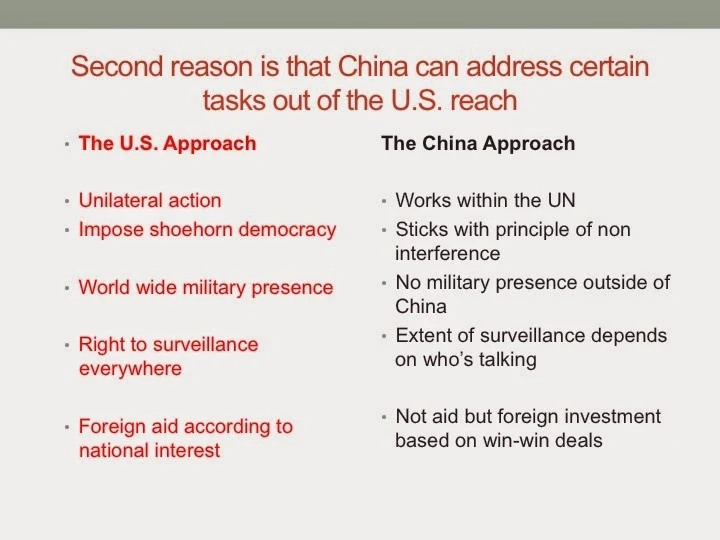
The second reason for being a friend of China is that China has a very different approach to international relations and can get things done that’s not possible by the American approach. Before giving you some examples of how China can accomplish certain international goals that the US cannot, let me summarize in this slide some the major differences in style to explain how these differences can lead to different outcome.

This slide compares some of the major differences between the US and China. The first bullet points out that the US, as the self acknowledged leader of the world, goes by the “my way or the highway” approach. China does not. Instead, China is always pushing for international cooperation and working within the United Nations charter.

Of the five permanent members of the Security Council, China has contributed more peacekeeper troops than the other four combined. Even here China has been very cautious, contributing engineering and medic soldiers and military police and avoided sending any weapon toting soldiers until recently.

Secondly, the US sees itself as the model for democracy and insists that democracy is the only acceptable form of government. Even so American attempts to introduce the democratic form of government in Afghanistan and Iraq could hardly qualify as raging successes. Lack of a winning track record has not kept our Secretary of State and us from energetically proselyting around the world on the virtues of democracy.

From TED Talk, Dambisa Moyo, a British educated economist from Zambia points out that even though roughly half of the countries in the world are considered to be democracies, seven out of 10 of these countries are what she called illiberal democracies. An illiberal democracy, subject to a variety of definitions, is one where the citizens get to vote but the votes don’t count, where there is freedom of speech but you have to be careful in how you exercise such freedom, you have access to news but all the media is state owned, and so on. Essentially illiberal democracy doesn’t work. I call it “shamocracy.”

China does not claim to be a democracy and they are frankly not too interested in the form of government they are dealing with. They respect the sovereignty of other countries and pretty much hewed to the principal of not interfering with the internal workings of any government. 

As I pointed out in the earlier slide, the US has military presence that ring around the world. China has not. Only in recent year or so that China’s navy has joined other countries on anti-piracy patrols in the Arabian Sea around the horn of Africa.

Whether it’s cyberspace or somebody’s airspace, the US asserts the right to surveillance anywhere and anytime they please. Mostly because they have the superior technology and therefore they can. So far as we know, China has not been flying spy planes over anybody else’s airspace. We don’t really know the extent of their cyber spying since the only reports we get are one sided from the likes of NSA and network security protection firms with vested interests in selling their services. Thanks to Snowden and other revelations, we do know that the US has the world’s best technology and does as much if not more cyber hacking than the rest of the world.

American foreign aid tends to come with strings attached whereas China is more likely to make investments where both the host country and China can mutually derive benefits. It’s true that some of the countries that China does business with can have leaders of rather unsavory character. But the US has also been known to give foreign aid to countries with doubtful regimes and overlook flaws of conduct merely because the national interests are aligned.

The real major difference is that cash is frequently part of the US package and cash is easy to divert into personal pockets and encourage corrupt practices. China’s deals tend to be non-cash based projects such as building roads, schools and hospitals. In Africa, for example, China has been more favorably regarded by the countries there than the US.
So what are some of the things China can do better than the U.S? How each dealt with the Ebola scare in West Africa is one straightforward example. While the US flew some of the patients to the US to get special therapy using as yet unproven anti-serum. China sent medical teams from China to work on the ground to help isolate the virus from contagion reaching epidemic proportions. Included in their mission of 6000 persons with 800 medical experts was to train 10,000 locals to deal with this disease for the long term. This turned out to be one occasion where President Obama did acknowledge and thank China for their humanitarian action.

After the American withdrawal from Afghanistan, China moved in to organize meetings between the new government headed by Ashraf Ghani and the Taliban. Both parties have enough confidence in China as an honest broker to agree to meet and hold conversations about the future of the country. This development was even reported on The New York Times and the front page of the Wall Street Journal including a thank you acknowledgement from the Obama administration.

I believe the Korean peninsula represents the most important example of what collaboration can achieve.

From the Clinton Administration to this day, the American side has always pushed for 6 party talks as a venue to negotiate and discourage North Korea from developing the nuclear bomb. Invariably just when we think the six-party conference is about to take place, the North Koreans find some maneuver to torpedo the meeting. Just as invariably, the Americans would throw their hands up in frustration and disgust and say to China, “you have the most influence on North Koreans, making them behave is your problem.” I know I am simplifying the history but the generalization will suffice for what I want about to suggest.

The North Koreans know full well that they have China in a conundrum. Even though the North Korean economy depends on China for life support, they know that China can’t afford to let the regime implode because under the existing treaty between South Korea and the U.S. If South Korea were to unify the peninsula then American troops can be stationed right on the Yalu River. Based on history and China’s relations with the U.S., China could never accept having American GIs on their border. In other words, China needs North Korea as a buffer from the American troops.

But what if Obama were to say to Xi Jinping that when and if the peninsula were to unify under the South Korean regime, the U.S. would immediately take all its troops off the peninsula? Think what would happen to North Korea if this becomes a binding understanding between China and the U.S. They could no longer blackmail China into continuing the lifeline in support of North Korea. They would have to behave and negotiate with the other parties and reach some kind of agreement on a nuclear free Korean peninsula.

It’s well known that Xi Jinping does not care for Kim Jong-un and gets along fine with President Park of South Korea. (He has met Park 6 times since taking over as head of China to zero with Kim.) What’s more, China is already South Korea’s biggest trading partner and China is where South Korea has made their largest foreign investments. South Korea is one of most popular travel destinations for Chinese tourists and South Korea K-pop and historical TV soaps enjoy wide following in China. The just concluded bilateral Free Trade Agreement will surely bring the two parties even closer together. One could even suggest that China-S. Korea relation is as good as any bilateral relation in the world!

The treaty between South Korea and the U.S. dates back to 1953 after the Korean conflict. It was to protect the south from the north. Since then South Korea has economically surpassed the north by orders of magnitude and would be quite capable of defending itself. Since at least 2006, questions were raised inside South Korea on whether the military treaty with the U.S. has become obsolete or at least unnecessary.

Just think if U.S. and China can build up enough mutual trust and confidence in each other’s intentions, the U.S. can save the yearly cost of posting 30,000 troops in South Korea, and in exchange finally attain a peaceful and nuclear free Korean peninsula--A goal that has eluded at least the last three presidents.

It goes without saying issues like global warming, anti-terrorism and cyber crime are all going to be easier to combat with the powers working together than not. We saw some indication of progress being made from the joint announcement between Obama and Xi last November after the Beijing conference of 20 nations.
As I alluded in an earlier slide, China has become a major source of foreign direct investments particularly for infrastructure around the world. By becoming a friend of China, the U.S. would have the opportunity to leverage from some of those investments and not have to expend our own resources in other cases.

This slide has a somewhat random selection of deals China has entered recently, not all directly affect American interest. The top one is most obviously not directly related to the U.S. In fact, you could say China was the beneficiary of American pressure on Russia, forcing Russian into the pipeline deal with China. Without the sanction and threat of sanction imposed by the U.S. on Russia, Russia may not have been so quick to strike a deal with China but would have looked for other buyers for their natural gas.

At the November APEC summit, Xi Jinping proposed the Asia Pacific basin as a free trade zone and 21 countries were quick to sign up. Rather than devoting resources and energy to push for Trans Pacific Partnership, it seems to me Obama would be better off dropping the moribund TPP idea and go along with the economic coalition proposed by Xi.

Before the APEC summit, China announced the formation of the Asian Infrastructure Investment Bank, supported by most of the Asian countries. While one can see the infrastructure bank as a potential rival to the World Bank and the IMF, it can also be seen as complementary or supplemental to the resources of the older more established banks. [Since my talk, the UK government has decided to become a founding member of AIIB incurring the displeasure of the Obama Administration. It would appear that the Cameron Administration has decided that aligning with China is in UK’s national interest.]

At the same November summit, Xi Jinping also announced the land based and maritime Silk Road initiatives (most commonly regarded as one belt/one road initiative). The idea of those initiatives is to promote and enhance economic development along the route. The land based goes thru central Asia all the way to Amsterdam and the maritime goes along the coasts of South Asia to the Middle East and beyond. All the countries along the route have been keenly interested in the possibilities of riding the crest of economic development. While not directly beneficial to the U.S. economy, the wealth generated along the route means those countries will become customers of American goods.

The last three items represent how the U.S. can benefit directly. The US has run out of money for space exploration while China is getting ready to send astronauts to the moon. It would make a lot of sense if the two countries were to collaborate and explore the universe together.

Investors from China are beginning to invest in the U.S. With friendlier relations, the flow of inbound investments from China could turn into a torrent.

Similarly, China is already the largest source of tourists going abroad and not only that, they are also the highest per capita spenders. Giving reciprocating 10-year, multi-entry visas was one of the brilliant moves by the Obama administration. Again as the two countries grow closer together, the number of visitors will increase.

Needless to say, both inbound investment and tourism will directly benefit the US economy.

Right now this is just a dream but according to railroad building experts in China, China already has the technology to build a high-speed train from China, over Siberia, under the Bering Sea and down Alaska, Canada to the U.S. The most challenging part is the 120-mile tunnel under the sea and China expert is confident that they already know how to do this. The 220 mph train can go from Beijing to San Francisco in about two days. The carbon footprint per passenger compared to flying is nearly one tenth. Four-country friendly relations would turn this dream into reality.
By avoiding the Thucydides trap, namely the alleged inevitability of conflict between a rising power and a reigning power, what value can we put on that? To quote a popular credit card commercial: priceless. What more do I need to say?
Recent Gallup poll of the American public revealed that China is no longer perceived as America’s number 1 enemy, a ranking China held as recently as two years ago. Now reality has intruded and Russia and ISIS have taken over as greater threats. So this may be a good timing to change the way we look at China. My last slide on what the U.S. needs to do to become a friend of China is based on a simple premise. Namely to become friends, we need to treat China as a peer and as an equal partner.

Certain congressional members on both sides of aisle like to criticize and tell China what they should or should not be doing. They do not necessarily know what they are talking about but they know that they will get ink and possible exposure on local and national TV.

A corollary to the first rule is that genuine disagreements, and there are certainly many, should be discussed and resolved in private meetings. While more of these meetings are taking place, we should be mindful that disputes voiced in public become hardened and difficult to resolve.

To my knowledge, China has not conducted any surveillance flights off the West Coast of the U.S. Other than acting as an irritant to China, I question the benefits of our surveillance flights off the coast of China. On the basis of mutual respect between peers, it would make sense to stop our flights.

President Obama recent visited Stanford to begin a national dialogue on cyber security and he emphasized that the government and the private sector can’t fight hacking on their own but need to work together. The same logic applies to the need for cooperation between nations. China and the US need to sit on the same side of the table in order to more effectively deal with the cyber criminals. Accusing each other merely allows the criminals to run amuck.

It’s becoming increasingly obvious that the civilized world face a common threat in the brutal jihadists movement. It is also clear that to effectively counter and contain the Islamic radicals, it would take the cooperation of all the sovereign nations. In that context, it does not help for the U.S. to somehow regard China’s terrorists as something less than bona fide terrorists.

Lastly, we need to appreciate that the Cold War is over and China is not looking to be the opponent of the next cold war. The neoconservatives in this country had thought that with the collapse of the former Soviet Union, it was time for the U.S. to dominate the world. Unfortunately from the fringe, they moved into the center of power with the election of George W. Bush. We are still paying for their hubris.

I hope we can start a new conversation about China because we need to save our country from a disastrous trajectory that could terminate the rich and powerful economy, as we know it, all because of foolish policies of our own making.

Friday, February 20, 2015

Haiping Su took on City Hall and won

The edited version of this article first appeared in New America Media.

Dr. Haiping Su was a victim of racial profiling and he sued the United States government and NASA for smearing his reputation, invading his privacy, depriving him of realizing his full career potential and causing him emotional stress and mental anguish.  He sued to clear his name and he asked for $5.2 million in damages.

Six (6) years later, after various delays, legal maneuvers and challenges, the judge heard the arguments and ruled in favor of the plaintiff, namely Dr. Su, and against the defendant, in this rare case the US government.  As compensation for damages, Su was awarded $10,000.

The lesson of Su’s experience with American justice has implications for all Chinese Americans working in technical disciplines in the United States and is worthy of more detailed examination.

In June 2008, Su was abruptly escorted off the premises of Ames Research Center in Mountain View, California and his access badge taken from him.  The only explanation given to him was that he had somehow become a security risk to NASA.

At the time, he had been working for about 3 years as a staff member of University Affiliated Research Center operated by UC Santa Cruz under contract to NASA.  He had come to the US from China in 1986, earned his PhD in agriculture science from Kansas State five (5) years later and became an US citizen.  His work for NASA related to his technical expertise.  The work was non-classified.

Approximately a month after getting his new identification badge to Ames in January 2008, the FBI asked to interview him for a “background check.”  The FBI did not approach any other member of his work group for a similar sort of background interview.

There was a second interview in March at the end of which he was told that he needed to take a lie detector test.  Afterwards, the FBI agent told him that he “did not do well” on the polygraph test but did not otherwise explain why Su was being investigated.

Early in April, Su was grilled by four (4) people representing FBI and NASA security to “clarify issues raised by the polygraph.”  Then on June 24, Su was handed a letter signed by Robert Dolci, head of security at Ames, stating that his continued presence constituted a security risk and he was escorted off the premises.

Dolci then called a meeting of Su’s coworkers and to their surprise, informed them that Su constituted a security risk.  Some of his coworkers later testified that Dolci implied that Su was removed from NASA Ames because he took money from a foreign government.

Early in July, Su’s supervisor at UCSC issued a letter of dismissal because he had allegedly failed the lie detector test.  Fortunately for Su, his supervisor compared the flimsy accusations against Su’s exemplary work record and decided to rescind his letter of dismissal.  He simply asked Su to telecommute and continue working from his home.

Su was understandably distraught by the treatment he received.  He contacted me and his story was still fresh in my mind when I happened to attend one of those Silicon Valley dinner meetings for technical professionals.  Jim McManis, partner in charge at McManis Faulkner, a prominent law firm in San Jose, was the speaker and he spoke about fair employment practices.

I was impressed by his forthrightness and his attitude about the importance of being fair, so I related Su’s story to him.  McManis was appalled and invited Su to contact him.  His willingness to take up Su’s case without fee made the historic lawsuit possible.

McManis’ firm filed the complaint on behalf of Su against NASA and the FBI on the grounds that Su was not involved in classified work, had no criminal history, was never told of the charges against him nor given a chance to defend himself, and lastly was not told of his right to appeal.

The complaint further charged that NASA in handling this case did not follow their own internal procedure and policy and thus deprived Su of due process, ruined his reputation and caused undue hardship and mental anguish.

In the court hearing, testimony by Su and his wife indicated that he had suffered greatly from this experience.  His wife testified that Su had undergone a personality change from outgoing to reclusive, from engaging to distrustful of people, and suffered from frequent bouts of depression.

The trial judge acknowledged that Dolci invaded Su’s privacy but he was unable to accurately assess damages done to Su, because Su continued to be employed.  In the end, the judge found for Su a sum of $10,000 as compensation for damages he suffered.

After the judge rendered his verdict, I asked Su if he felt vindicated and if he had any regrets.  He said that even though it became a six-year nightmare and he had to pay a personal price suffering from insomnia and hypertension, he would do it again.

He was convinced that the only way to stop racism was to stand up and object.  He didn’t fight just for himself, he said, but also for all Chinese Americans working in the U.S.

The Wen Ho Lee case at the turn of the century was perhaps the most notorious, but racial prejudice since then against professional Chinese Americans working in technical disciplines has not subsided.

Chinese Americans have continued to be accused, harassed, and thrown out of work.  Subjected to personal ordeal, including sitting in jail without bail, the victims frequently find the government accusers lose interest and drop all charges—not before, of course, having inflicted financial devastation and character destruction on their hapless victims.

Su’s case has been one exception where the Government did not get away with arbitrary and discriminatory actions and not have to pay a penalty.


Thursday, January 22, 2015

Internationalization of the renminbi

From time to time, I have reported on the growing use of the Chinese currency, the renminbi, in international trade. See here for my most recent update. The latest 3rd party update came from a recent issue of Wall Street Journal.

According to the WSJ report, nearly 25% of all the transactions across China's borders in 2014 were settled with the yuan. Fifty countries used the yuan for at least 10% of their trade with China. It is now the seventh most used currency according to Swift international payments.

According to China's central bank, the amount of renminbi used for international payments for 2014 was equivalent in value to $1.6 trillion in dollars.

A later Financial Times article gave an overall view of all the world currencies used in international transfers. The Chinese renminbi has now risen to 5th overall in volume of use.


Tuesday, December 2, 2014

Book Review: Can China Lead?

This book is published by Harvard Business Review and my review first appeared in Amazon.

If the authors had posited the rhetorical question from the geopolitical point of view, the short answer would be: "Yes, China can lead though not in the confrontational style favored by the Americans." When applied to doing business in China or by Chinese companies on the global stage as the authors intended, the answer is more nuanced and complex. The authors tried hard and deserve a "B" for their effort but they missed the bullseye. 

This thought provoking book loaded with information and case histories (in the tradition of Harvard Business School) is highly instructional for those wishing to understand today’s China, especially the business environment of China. While the authors provided a balanced discussion of the complexity of a society undergoing breathtaking rate of change, the analysis that accompanied the discussion was often too light and not fully satisfying.

The book began with a historical review demonstrating that much of China’s centrally planned policies had the roots in the early republic days as proposed by Sun Yat-sen, the founding father of modern China. Contrary to Western perception, many of China’s policies were not invented by China’s Communist Party but preceded CCP’s coming to power.

The authors then described the rapid development of China’s economy alongside intensive investment in infrastructure that has been unprecedented in human history. They attributed the success to China’s leaders being trained in engineering, as opposed to emphasis in law as is the case with western political leaders.

The book presented many successful business cases as well as failures. Both categories included state-owned enterprises as well private ones founded by entrepreneurs. Reasons for their success or failure were useful and instructional. The book also talked about China’s rapid expansion of the capacity to train college graduates and China as emerging source of outbound foreign direct investments. 

While the description of China’s impressive economic progress was positive and fair in giving the policymakers their due, there was an undertone of nagging concern that China’s miraculous development won’t last. Because of China being a single party rule, they expect the nation to eventually hit the wall. As I read the book, I kept waiting the other shoe to drop. That is, I waited for an analysis and explanation of why China will ultimately fail but that conclusion while hinted was never articulated.

It is somewhat unfortunate that the book went to press just after the sentence of Bo Xilai. To the authors’ credit, they did not simply dismiss Bo’s downfall as political infighting between his losing faction and Xi Jinping’s winning faction—as some western pundits have suggested. Had they waited a bit to see the full implication of the anti-corruption drive, still on going today, they might have a more hopeful prognosis on China’s future.

I suppose it’s unrealistic for a less than 200 page book to fully cover the many facets of China, some contradictory and conflicting, and some too complex to lend to straightforward analysis. For example, the authors devoted one paragraph on the likelihood of military conflict with the U.S. and their concluding sentence was: To the extent there is a Chinese-American competition, we believe it will be primarily economic, not military, in nature. Wow, there were a lot of whys and why-not’s that they didn’t talk about.

In discussing the rise of China, especially in the early years after Deng Xiaoping return to power, the authors did not discuss the critical (in my view) roles of Hong Kong businesses relocating into Shenzhen and Taiwan manufacturing companies into Dongguan and Kunshan. They were in China well ahead of significant western presence and their factories began the knowledge transfer of good manufacturing practices to the indigenous factories, heretofore indoctrinated by the “iron rice bowl” mentality wherein quality and productivity did not matter.

While the book drew linkages to early republic days just after the fall of the Manch  dynasty, it barely mentioned the early signs of privatized venture led by the so-called township enterprises (乡镇企业) in the early days of economic reform. To my knowledge no one has really gone to the trouble of figuring out why the TVEs had such meteoric rise and why they flamed out.

The book also did not talk about how failing SOEs were “rescued” by some energetic entrepreneurs, usually an insider, taking the small efficient part of the operation with greatly reduced payroll and restart as a stock holding company. In exchange for a minority equity in the new company, the local government was left to deal with closing and laying off the greater part of enterprise beyond economic salvage. Some newly formed company raised capital by agreeing to relocate to the outskirts and giving up the dilapidated facility located in the heart of town to the local government for cash, whereupon the government would raze the old factory and build new shopping mall or office building or high rise apartments. Everybody won.

The round-trip funding of the newly formed privately held company also played a critical role in the early days of economic reform. “Round trip” refers to the secret transfer of funds from inside China to Hong Kong and then remitted back to China as qualified foreign direct investment, sometimes accompanied by addition of fresh funds from Hong Kong. The motivation for the round tripping was that any enterprise with 25% or more equity belonging to the foreign investor qualified as foreign invested enterprise and FIEs were eligible for favorable tax treatment and other concessions.

“Above are rules, below are ways around the rules (上有政策,下有对策)” is one saying everybody in China is familiar with. It is very much ingrained in the Chinese business culture and something every western business in China needs to keep in mind. The authors emphasized the importance of western companies understanding and getting along with the national and local governments in China. Very true. The challenge is that nothing in China is black or white but in shades of grey--nothing to do with sexual bondage but everything to do with staying out of FCPA related indictments back home. Knowing where the line is and not stepping over the line is the daily challenge for the expat manager.

While there was an impressive collection of cases presented in this book, there were some gaps I could nit pick. For example in discussing China’s rising trend to consumerism, they talked about the competition of Ford and GM to win the hearts and minds of the Chinese consumer. Actually VW, who was in China years before GM or Ford, has been much more a competitor to GM than Ford.  Breathing down their collective necks are the local privately held entities as well as the big state-owned auto companies that are in bed with the western automakers.

Also as part of the discussion on China’s rising consumerism, the authors studied the use of credit card companies as a “growing appetite for consumer debt.” Missing in the discussion is a much needed, more expansive study of the Chinese consumer (or is it the government) that resisted the use of outside credit cards such as Amex, Visa and MasterCard until the introduction of UnionPay, a Chinese version of a universal credit card. What made UnionPay successful? What was the government’s role?

In fact, an entire new chapter could be devoted on how Chinese companies emulated a successful western business and localize the model in order to succeed in China. Examples would include Baidu over Google and Alibaba over eBay and Amazon. The authors suggested that the government tilt the field in favor of the Chinese companies but I believe there was more to it. The Chinese entrepreneurs understood the local culture and practices and made sure theirs was an approach that took advantage of their understanding. An interesting case to watch for possible inclusion in their next edition of this book will be the rise (and more rise or fall) of Xiaomi in the highly competitive mobile phone market.

The authors devoted only one sentence to the turbine maker: Sinovel was also accused of stealing proprietary wind turbine technology from its American main supplier. This was somewhat misleading because the dispute was over alleged theft of software, and as the authors rightly pointed out, software was not a strength of Chinese companies. Actually the authors missed an opportunity to develop a case study on how to develop a strategic partner and avoid a nightmare. (The damaged American company was located in Massachusetts and should have been easy to interview.) Instead of same bed, different dream, based on the Bloomberg report, I suggested that the American executive missed the opportunity to form a classic win-win relationship, a virtue the Chinese love to extoll.

The authors are using this book for one of their China related courses. It is a worthy first effort but I would expect future revisions and editions, if for no other reason because China is still very much a moving target. As I suggested in this review, to do justice to this subject, the book needs to be much bigger, at least twice the number of pages accompanied by more in-depth analysis.


Thursday, November 20, 2014

Make Abe a global persona non grata until he stops denial

The New York Times recently published an opinion piece on comfort women and Japan's continued denial by Ms. Mindy Kotler. Ms. Kotler pulled no punches as she presented a long list of rape and violence by the Japanese soldiers on women throughout the war. She criticized the Abe administration for their vigorous effort to revise history and restore Japan's imperial wartime honor. This was another timely reminder of Japan's national amnesia over the WWII atrocities committed by the Japanese imperial troops.

Until Japan wakes up from its amnesia, the world cannot forget the trauma of the hundreds of millions brutalized by the Japanese. This was particularly true for nations in the Asia Pacific. The best way to jolt Japan's collective memory is to make sure the shame of world wide censure overwhelms the comfort of hiding under continued denial.

In Germany and other parts of the world, school children are taught about the European Holocaust perpetrated by Nazi Germany that killed millions of Jews. Deniers of the Holocaust can be sent to prison. In similar vein, to drive home that Abe cannot get away with denying the Asian Holocaust, let international community declare Abe and all members of his cabinet as persona non grata and denied passage or entry to any other country. The precondition to lifting the travel ban would be only after they have rectified the textbooks missing the actual history and publicly informed the Japanese public of the truth of WWII.

Rather than seeing themselves as the victims of WWII, Japan must accept its responsibility as the perpetrator of atrocities of a magnitude beyond human imagination and understanding.

As the recognized leader of the world, the U.S. government must make the first official proclamation that Abe and his cabinet officials are, until further notice, no longer welcomed in the United States. Other nations will surely follow suit, but even if not all go along with America, the shock of the American indignation would surely catch Japan's attention. When losing face by continued denial far outweigh the pain of owning up its sordid past once and for all, Japan may finally join the community of nations with a conscience.


Wednesday, November 12, 2014

Book Review: One Man's View of the World

My friend, Ken Fong, found the book so compelling that he bought a bushel so he can give a copy to each of his friends as he ran into them in daily encounters. At age 90, this is most likely the last book by Lee Kuan Yew. Lee was Singapore’s first prime minister in 1959 and led the city state to full independence in 1965 when the rest of Malaysia rather unceremoniously invited Singapore to go their separate ways. By the time he stepped down in 1990, Singapore has been transformed into a First World metropolis. His is a legacy of what good government is like and how a successful national leader should behave.

As the book jacket stated, with little else left to prove, he looks ahead to offer his unvarnished view of the future shape of the world. In reading his view of the world, the reader will come to understand the core beliefs of this remarkable man. Some of these include:

(1) For any nation to succeed, clean government is a must. Road to a clean government is to pay the civil servants generously so that there is no reason for corruption. For those that do stray and gets caught, the punishment needs to be harsh for betraying the public trust.

(2) Democracy is no panacea. If the citizens are poorly educated and have no idea of what democracy is all about and if the country lacks a history of progressive thinking and culture of individual equality, the introduction of democracy will fail. As Lee predicted in his book, winter inevitably followed Arab Spring because tribal based feudal systems of the Middle East cannot nurture democracy.

(3) Education is the necessary foundation to any successful developing nation and the access to quality education must be equal to all citizens, male and female. Educated workforce is vital to economic development and a growing economy gives the population opportunities to a better life and thus a willingness to support their government. Thus in his view, the caste system will always hold India back from realizing its full potential and keeping women from education will block the development of Islamic countries.

(4) Diversity in a population trumps homogeneous population because diversity means more diverse gene pool and greater range of creative thinking and capacity for innovation. From his point of view, the U.S. greatest strength is its welcoming attitude towards immigrants. By the same token, Japan’s inability to accept anything foreign, even ethnic Japanese who has lived abroad is the root of its inevitable decline.

Hi book deals with major global topics and each major regions of the world.  On China, his impression of Xi Jinping is in the “Nelson Mandela class of persons,” and Deng Xiaoping is undoubtedly the most impressive international leader he has ever met. Key difference between the US (a benign power) and China is that China does not believe in “evangelizing their form of government.” His biggest concern on China is if the future young generation of Chinese, not having experienced the challenges of China’s difficult past, gets overly nationalistic and aggressive.

From his visits to the U.S, “I came to appreciate fully the dynamism of the entrepreneurial American.” Lee sees long-term success of the U.S. resting on its ability to continue to attract “bright and restless immigrants from the world.” As for the competing influences of the U.S. and China in Asia, he felt that even though the US military budget is still six times greater than that of China, China has advantage of proximity in competing for influence in its neighboring states. He seems to think that both sides need to find mutual accommodations around a stale mate.

Lee is considerably less optimistic about Europe. He sees two major hindrances. The flaw behind the Euro is monetary integration without fiscal integration between 27 nations with wide and disparate of economic development. He sees no hope for fiscal integration ever. Europe is afflicted with the welfare state mentality and stifling labor laws that discourage entrepreneurialism, innovation and striving for productivity. Rather condescendingly, Lee thought Europe might be able to get away with the welfare state mind-set if they were competing with Fiji or Tonga.

The book jacket endorsements list some of world’s who’s who as heads of state, diplomats and international notables.  But I don’t think that was the reason Ken liked the book so much that he became a volunteer propagandist of Lee’s worldview. In Lee, he sees and the world sees a great statesman who successful synergized his impeccable western education with his innate Asian values to show the world how a small port city can integrate into the global economy and let the people thrive. The politicians in Washington would do well to read and heed the lessons he learned.